
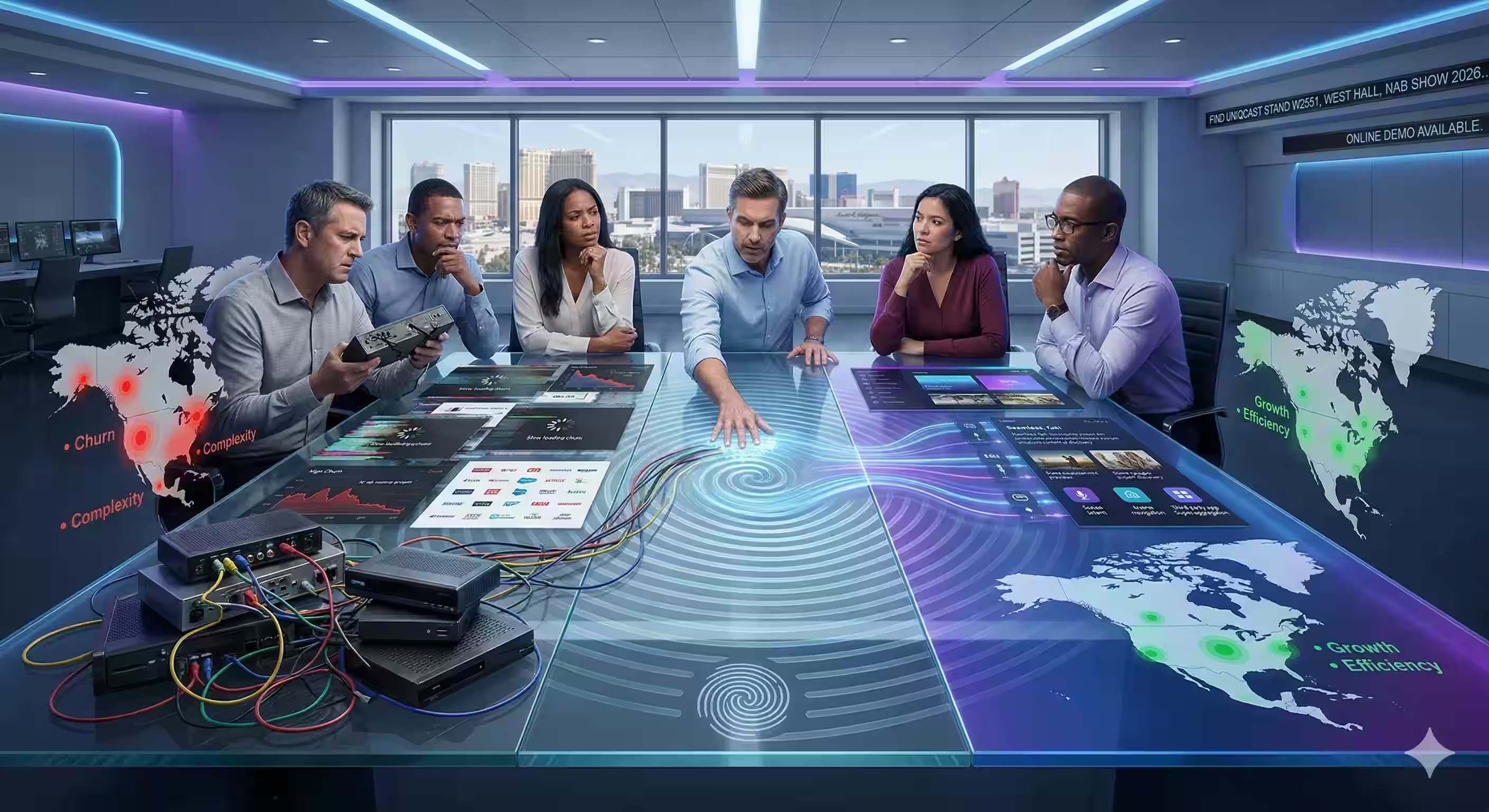
Why U.S. broadband and video service providers are reassessing their IPTV/OTT platforms
Resumen rápido
Across North America, something is clearly shifting.
More and more regional broadband and video service providers are reassessing their IPTV/OTT platforms — not because they want to innovate for the sake of it…
But because operating video services has become increasingly complex.
- High support costs.
- Fragmented vendor stacks.
- No clear roadmap.
- Increased operational cost.
And the reality is simple:
Most operators are no longer struggling with what to do.
They’re struggling with why it’s not working yet.
The Questions Have Changed
A few years ago, the conversations were easy.
- “We need an OTT app.”
- “We should launch on Android TV.”
- “Let’s add catch-up and maybe some VOD.”
Now?
The tone is different — and you can already feel it in conversations across the continent:
- Why is churn still high?
- Why are users dropping off after a few minutes?
- Why does our platform feel slow compared to Netflix?
That shift matters.
Because once you start asking those questions, you’re no longer in launch mode.
You’re in accountability mode.
The Problem Isn’t Awareness Anymore
Nobody in the North American market needs convincing that OTT matters.
Everyone already knows:
- Apps are expected
- Multi-screen is standard
- UX directly impacts retention
And yet…
A lot of platforms still feel like they’re one step behind.
Not because teams don’t understand the problem —
but because the technology underneath them can’t keep up.
Complexity Is Becoming the Real Cost
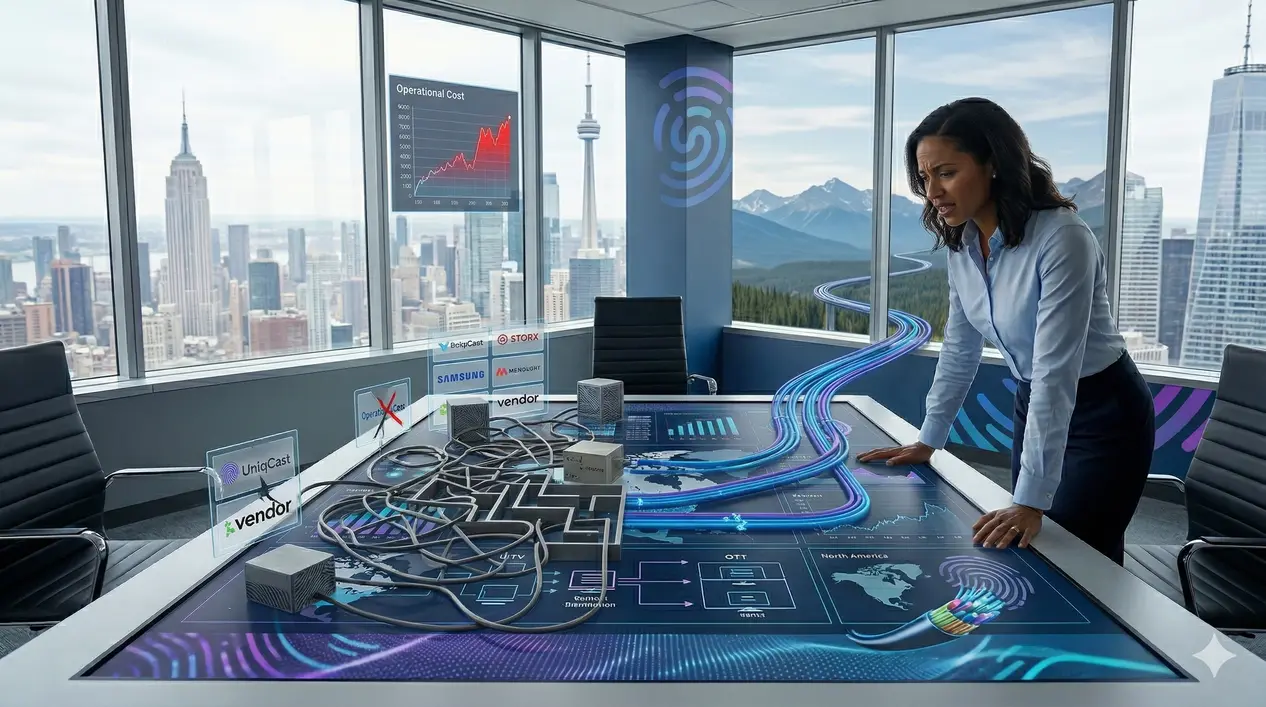
One theme that keeps coming up in conversations:
“We know we need to move… but it’s complicated.”
That usually translates to:
- Systems that are hard to upgrade
- Integrations that break when you touch them
- Long release cycles for even small improvements
- High operational workload
On paper, everything works.
In reality, everything is just slow enough to hurt the business.
And this is where it becomes more than a technical issue.
It becomes a cost and efficiency problem.
Maintenance increases.
Operational complexity grows.
Teams spend more time fixing, managing vendors than improving the service.
And every delay?
It directly impacts revenue.
The Integration Trap
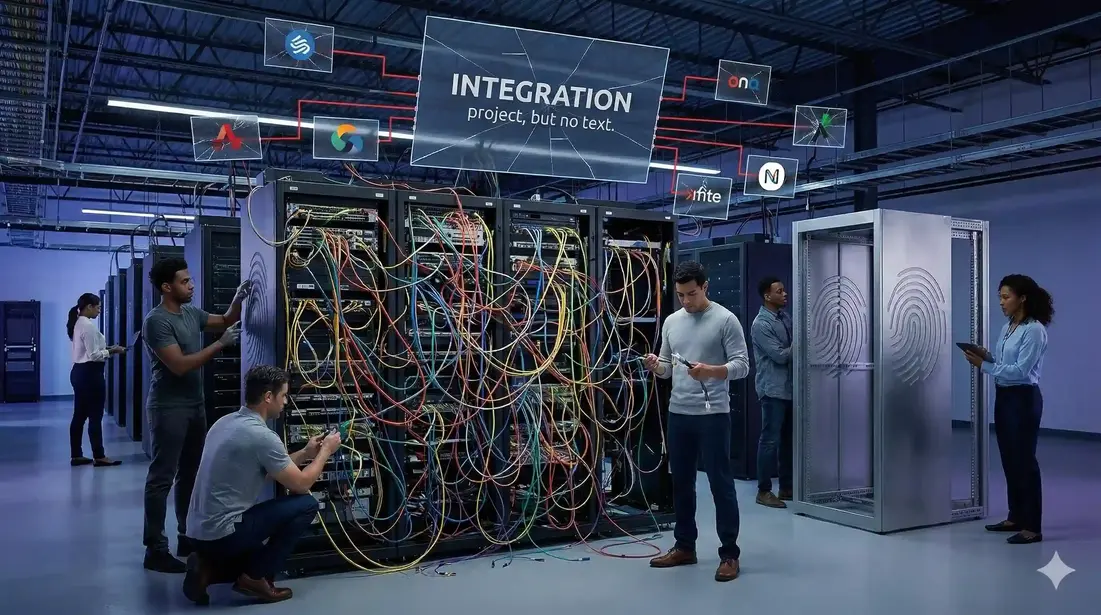
There’s also a pattern we keep seeing.
At some point, everyone tried to build the “perfect stack”:
- One vendor for backend
- Another for apps
- Another for recommendations
- Another for analytics
Flexible. Scalable. Future-ready.
And, that it, preferably, works on legacy STBs as well.
Until it wasn’t.
Because now you’re not running a platform —
you’re running an integration project that never ends.
And every new feature?
It’s another dependency. More coordination. Another delay. Another cost.
What looks flexible on paper often becomes expensive in reality —
both in time and operations.
UX Is the New Baseline
This is probably the biggest shift.
UX used to be something you improve over time.
Now it’s the baseline.
Users expect:
- Fast startup
- Instant channel change
- Simple navigation
- Effortless content discovery or better said - Content that finds them
And they’re not comparing you to the local competitors.
They’re comparing you to YouTube, Netflix, and everything else they use daily.
That’s a much higher bar.
And if your platform can’t deliver that experience consistently…
Users won’t wait.
Super-Aggregation Is Becoming the Default

Another thing that’s becoming obvious:
Video service providers are no longer just distributing content.
They’re becoming platforms:
- Aggregating third-party apps
- Bringing in external content catalogs
- Creating unified viewing experiences
The goal is simple:
Keep users inside your environment — even when the content isn’t yours.
Because the longer they stay, the more value you create.
AI: From Buzzword to Roadmap

AI is talked about everywhere at industry events across North America just like the NAB Show — but the difference now is how it’s being used.
Not as a concept.
As a tool.
- Smarter content discovery
- Scene-level navigation
- Automated short-form previews
- Voice and intent-based interaction
Not “nice-to-have” features.
Real use cases that directly impact engagement.
So What’s the Real Issue?
After enough conversations in the North American market, one thing becomes clear:
The industry doesn’t have a feature problem.
It has a foundation problem.
You can keep adding features.
But if the platform underneath isn’t built to support them properly…
You don’t move faster.
You slow down.
And This Is Where It Becomes a Business Decision
At some point, this stops being about technology.
Because:
- Slow releases = lost opportunities
- Complex integrations = higher operational costs
- Poor UX = higher churn
This directly impacts revenue, margins, and growth.
And in today’s market, that’s not sustainable. Legacy platforms don’t just fall behind. They become too expensive to maintain and too slow to compete.
UniqCast POV - A Different Approach: Simplifying Without Compromise
Across North America, broadband and IPTV/OTT service providers are moving away from fragmented setups, complex integrations, patchwork solutions and toward unified platforms with simpler operations and faster execution.
Platforms that:
- Reduce operational complexity
- Accelerate time-to-market
- Improve user experience
- And lower total cost of ownership
Not because it’s easier. But because it works.
We help service providers modernize IPTV/OTT delivery through a managed, end-to-end platform that simplifies operations while keeping full control over branding and customer experience.
And importantly:
You don’t need to start from scratch.
We would be happy to demonstrate how you can get all of that — and more — packaged in a single end-to-end solution, deployed in the cloud or on-premise, that is completely future-proof.
And even enables you to keep your existing, legacy STBs.
Let’s Meet at NAB Show 2026
We’ll be attending NAB Show 2026 in Las Vegas and would be glad to show how you can modernize your IPTV/OTT platform risk-free — while keeping your existing infrastructure where it makes sense.
Find us at stand W2551 in West Hall
Book your time slot HERE
Not attending NAB 2026?
No problem.
Simply reach out to us HEREand we’ll set up an online demo to walk you through everything.
Final Thought
NAB 2026 probably won’t introduce a new trend.
In North America, that shift is already happening.
It will confirm something most video service providers already feel:
Legacy platform = Losing profits
At some point, you either:
- Keep working around limitations
or - Fix the foundation and move forward properly
Because when your platform starts slowing you down…
That’s not a technical issue anymore.
It’s a business decision.
Is your platform ready to keep up?