
Meet UniqCast at IBC 2026: It’s Time to Talk About the Future of IPTV/OTT Operators
Quick Summary
IBC has always been one of the best places to talk about where the video industry is going next.
But in 2026, we believe the conversation needs to go one level deeper.
It is no longer enough to ask which IPTV/OTT features operators should add next. The bigger question is this:
Will operators still own the viewer relationship five years from now?
Because this is the real battle.
Not only bandwidth.
Not only content delivery.
Not only another app, another device, or another feature on the roadmap.
The next phase of IPTV and OTT will be about who controls discovery, engagement, monetization, and the customer experience when content is everywhere.
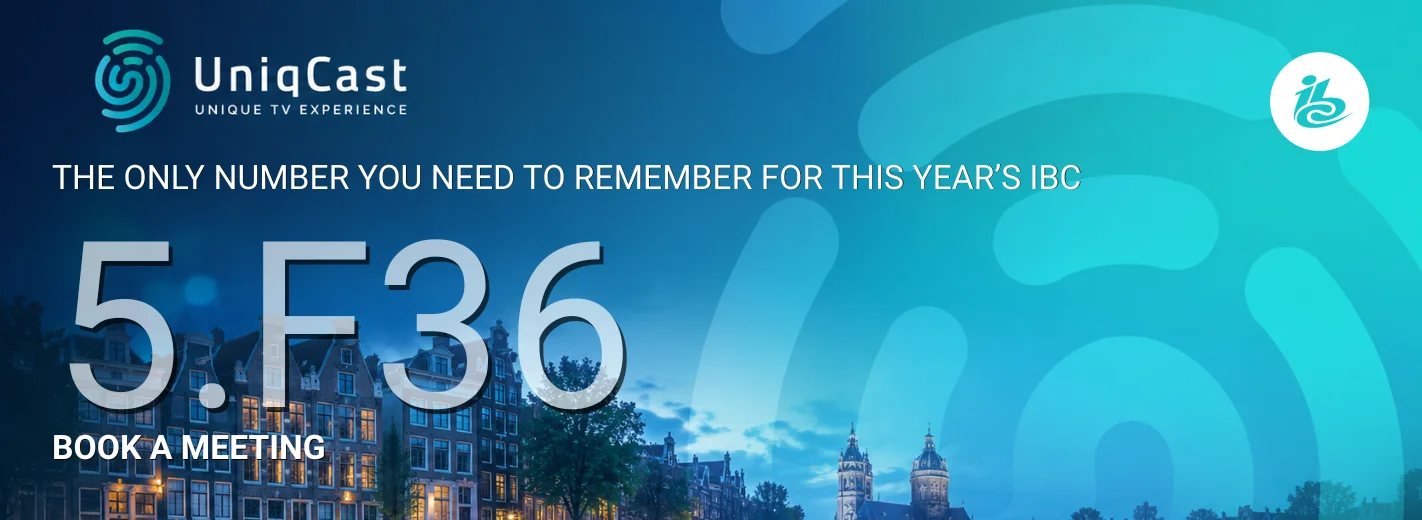
That is why UniqCast will be at IBC 2026 in Amsterdam from 11–14 September, meeting with telcos, ISPs, broadcasters, pay-TV providers, and content owners who are thinking seriously about the future of their TV business.
If you are attending IBC 2026, we would be happy to meet, exchange ideas, and show you how UniqCast can help you build a modern IPTV/OTT service that is ready for what comes next.
From content delivery to customer ownership
For years, the operator TV conversation was mostly about delivery.
Can we deliver linear TV?
Can we support catch-up TV?
Can we launch multiscreen?
Can we replace old middleware?
Can we move to OTT?
Can we reduce operational complexity?
All of these questions are still important.
But they are no longer the whole story.
Today, many operators are facing a much bigger challenge. Viewers are surrounded by global streaming platforms, smart TV ecosystems, social video, sports apps, FAST channels, and endless content choices. The viewer experience is becoming more fragmented, while global platforms are becoming better at owning attention.
That changes the role of the operator.
The operator cannot be just the company that delivers the stream. The operator needs to remain the place where viewers find content, enjoy content, return to content, and build habits around the service.
Because if someone else owns the home screen, the recommendation layer, and the daily viewing habit, then the operator’s role becomes smaller.
And nobody wants to become just the invoice behind someone else’s entertainment experience.
Why this matters now
There is a reason this conversation feels urgent.
Consumers have more content than ever, but that does not mean they have a better experience. Many households are tired of switching between apps, searching across different services and paying for multiple subscriptions without a simple way to manage the experience.
At the same time, viewer expectations are higher than ever.
People do not compare operator TV platforms only with other telco platforms. They compare them with Netflix, YouTube, Disney+, TikTok, Spotify and every other digital service they use daily.
That means slow interfaces, poor search, confusing navigation, and limited personalization are no longer small problems. They are business problems.
Good enough is no longer good enough.
For telcos, ISPs, and pay-TV operators, this creates both risk and opportunity.
The risk is clear: if the operator experience does not evolve, viewers will spend more and more time inside global platforms and less time inside the operator environment.
But the opportunity is just as strong: operators can become the trusted aggregation layer that simplifies the viewing experience, combines local and global content, supports multiple business models, and keeps the customer relationship alive.
That is the future we want to talk about at IBC 2026.
What we will be discussing at IBC 2026
At UniqCast, we work with operators across five continents, which gives us a practical view of what is happening in different markets, not just in theory but in real deployments.
Some operators are replacing legacy IPTV systems that are slowing them down. Some are launching new OTT services. Some are exploring cloud models. Some are building stronger Android TV strategies. Some are looking for better content aggregation. Some want to improve discovery, UX, and engagement. Some are trying to reduce operational burden while still keeping full control over their service.
The markets are different, but the direction is similar.
Operators need more flexible platforms.
They need faster innovation cycles.
They need better viewer experiences.
They need more intelligent content discovery.
They need business models that go beyond traditional TV packages.
And they need technology that supports growth instead of blocking it.
At IBC 2026, we will be focusing on the areas that matter most for the next stage of operator TV.
Legacy platform replacement
Many operators are still running IPTV systems that were built for a different era.
These platforms may still function, but they often make every new step harder: adding new devices, improving UX, integrating apps, launching new monetization models, introducing AI-powered discovery, or scaling across multiple networks and markets.
Legacy platforms do not always fail suddenly. More often, they slowly limit the business.
They make innovation slower.
They make integrations more complex.
They increase operational pressure.
They make it harder to compete with global streaming experiences.
At IBC 2026, we will show how UniqCast helps operators move from outdated systems to a modern, flexible IPTV/OTT platform without unnecessary complexity.
IPTV/OTT platform for real operator needs
There is no single perfect model for every operator.
Some need a full end-to-end IPTV/OTT solution.
Some need a managed cloud platform.
Some need hybrid deployment.
Some need on-premise control.
Some need DVB integration.
Some need multiscreen apps.
Some need faster time to market with lower operational effort.
This is why flexibility matters.
UniqCast supports operators with an end-to-end platform that can include backend, CDN, content protection, multiscreen applications, Android TV, DVB, analytics, integrations, and professional services.
The goal is not to push one model everywhere.
The goal is to help operators choose the model that fits their market, their infrastructure, their budget, and their business strategy.
Android TV strategy
Android TV continues to be one of the most important topics for operators.
But the conversation should not stop at devices.
For us, Android TV is a strategic question.
How much control does the operator have over the experience?
How does Android TV fit into the wider IPTV/OTT platform?
How are apps, content, search, and recommendations presented to the viewer?
How does the operator protect its brand and customer relationship?
How does the platform support future services and monetization?
A good Android TV strategy can help operators modernize the living room experience, reduce device complexity, and offer viewers a more familiar environment.
A weak strategy can turn the operator into just another icon on someone else’s screen.
That difference matters.
Content aggregation and discovery
The viewer does not care how complicated the content ecosystem has become.
They just want to find something good to watch.
This is why aggregation and discovery are becoming central to the future of operator TV. Operators have an opportunity to bring together linear TV, catch-up TV, VOD, third-party apps, premium content, FAST channels, sports and local content into one more useful experience.
But aggregation is not only about putting more content into one place.
It is about making that content easier to discover, easier to navigate, and easier to enjoy.
This is where features like advanced content discovery, better metadata, smarter recommendations, voice search, and AI-assisted navigation become more than nice additions. They become part of the operator’s ability to stay relevant.
UX that can compete with global platforms
A modern IPTV/OTT platform needs to feel modern.
That may sound obvious, but it is one of the biggest challenges in the market.
Viewers have become used to premium digital experiences. They expect speed, simplicity, personalization, and continuity across devices. They expect services to work naturally. They expect the interface to help them, not slow them down.
For operators, UX is no longer only a design topic.
It affects engagement.
It affects churn.
It affects upsells.
It affects the perceived value of the entire TV service.
At IBC 2026, we want to talk with operators about how to move from “functional TV” to a better, more premium viewer experience that can compete in today’s streaming environment.
Sports as an engagement engine
Live sports remain one of the strongest reasons people subscribe, stay subscribed, and return to a TV service.
But sports viewing is also changing.
Fans want more than a live broadcast. They want instant highlights, statistics, replays, key moments, second-screen experiences, and easier ways to follow the teams and competitions they care about.
This creates new opportunities for operators.
Sports can become more than premium content. It can become a powerful engagement engine inside the IPTV/OTT experience.
For operators that have sports rights or strong sports packages, the next opportunity is to build richer experiences around that content and make it easier for fans to stay engaged before, during, and after the event.
Monetisation beyond the traditional package
The future of operator TV will not be built only on one business model.
Subscriptions will remain important, but operators also need to think about advertising, FAST channels, transactional content, premium add-ons, app partnerships, B2B services, sports packages, and more flexible bundles.
The platform has to support this.
It needs to allow operators to test, adapt, and launch new commercial models without turning every change into a long and expensive project.
This is where the business side and the technology side meet.
The right platform does not only deliver content. It helps the operator create new revenue opportunities.
Why meet UniqCast at IBC 2026?
Because we do not look at IPTV/OTT only as technology.
We look at it as a business platform for operators.
Our experience across five continents has shown us that every market has its own reality. Some operators need to replace legacy systems. Some need to launch fast. Some need to simplify operations. Some need more control. Some need stronger UX. Some need to protect their TV business from global platforms. Some need to create entirely new revenue streams.
That is where UniqCast can help.
We bring the platform, the integrations, the services and the practical deployment experience needed to turn these ideas into a real service.
No empty buzzwords.
No one-size-fits-all story.
No “future of TV” presentation that ignores the business reality of operators.
Just a practical conversation about where your TV service is today, where it needs to go next and how to get there without unnecessary complexity.
Let’s meet in Amsterdam
If you are attending IBC 2026, we invite you to meet the UniqCast team in Amsterdam.
Whether you are planning a new IPTV/OTT service, replacing a legacy platform, exploring Android TV, improving your multiscreen experience, adding content aggregation, building a sports strategy or looking for new monetisation models, we would be happy to talk.
IBC is a great place to see what is new.
But more importantly, it is a great place to ask what actually matters.
For operators, the next five years will be crucial. The question is not only who can deliver content everywhere.
The real question is:
Who owns the viewer when content is everywhere?
Let’s talk about that at IBC 2026.
Book a meeting with UniqCast and visit us in Amsterdam from 11–14 September 2026.