
The Technology Stack for Mobile OTT Growth
Quick Summary
The Mobile TV Playbook, Part 3
This article is Part 3 of a broader series based on the whitepaper The Mobile TV Playbook, which explores how mobile operators can build competitive OTT video services around the realities of mobile viewing, evolving customer expectations, and new monetization opportunities.
In this third part, the focus shifts to the technology stack behind a successful mobile OTT proposition. The key question is how operators should build for engagement, retention, and monetization in mobile-first environments. From private CDN deployment and super-aggregation to AI-driven discovery, low-latency live streaming, dynamic catalogs, and offline viewing the strongest technical choices are those that reduce friction and make streaming feel immediate, relevant, and premium. Just as importantly, this part shows how those capabilities come together to turn live sports, concerts, and breaking events into a genuine mobile growth engine.
The Technology Stack for Mobile OTT Operators

Mobile OTT operators win by deploying a focused stack that delivers three outcomes repeatedly: higher engagement, lower churn, and stronger monetization per user. The strongest technology choices are those that reduce friction, improve perceived value in the first session, and make live moments and mobility feel premium.
Private CDN to optimize costs and performance
The ability to implement a private OTT CDN within one's own private infrastructure, is exceptionally valuable for mobile operators. This is because mobile networks typically involve significantly higher bandwidth costs and capacity limitations compared to fixed network operators. By deploying a private CDN, mobile operators can keep high-demand content traffic within their network, substantially reducing backhaul costs, optimizing network performance, and ensuring a higher quality of experience for mobile users, even during peak hours.
Super-aggregation that is real, not just resale
Super-aggregation becomes valuable when it removes the two biggest sources of streaming fatigue: too many services and too much effort to find content. Industry analysts have positioned super-aggregation as a strategic path for service providers facing fragmentation.
A commercially effective super-aggregation layer typically includes:
- Unified subscription management inside the operator app, including activation, upgrade, downgrade, pause, and cancellation across partner services
- Unified identity and entitlement so users do not repeatedly authenticate across apps
- Cross-service search and discovery that surfaces results from operator content and partner catalogs in one place
- Unified billing with plan integration, family plans, and add-on passes
What makes this lucrative is the ability to steer customers toward higher-value bundles, to reduce churn by making the operator the default home for streaming decisions, and to create incremental revenue through partner distribution while keeping experience ownership.
AI-driven discovery that is tuned for mobile intent and short sessions
On mobile, discovery is the product. If users do not find something quickly, they leave. Global platforms are doubling down on AI-enhanced discovery. Netflix announced an AI-powered search experience that supports natural language queries and a redesigned interface to improve findability.
Mobile operators should treat AI-based content discovery as a system with four layers:
- Intent capture through search, behavior signals, and contextual cues such as time of day and session length
- Candidate generation across all catalogs the user is entitled to
- Ranking and packaging that optimizes for immediate playback and long-term retention, not only click-through
- Presentation optimization that tests rows, thumbnails, and messaging continuously
For mobile OTT, the most valuable AI outputs are mobile-specific moments such as what to watch in the next ten minutes, what is live now that matches my preferences, and what should I download before I lose coverage.
Conversational assistants and voice interfaces

Voice and conversational interfaces are shifting from basic voice search into interactive assistants that can answer questions, guide discovery, and control playback in natural language. Recent platform moves show how mainstream this is becoming, including UniqCast featuring AI-Voice Assistant, Google TV integrating Gemini as an on-screen assistant experience and Roku expanding AI capabilities in its voice assistant.
For mobile operators, the strongest use cases are practical and commercially measurable:
- Conversational search across aggregated catalogs using mood, context, and time window
- Spoken queries for live events such as show me live matches starting soon
- Interactive help that reduces support load such as playback troubleshooting and account guidance
- Accessibility improvements through voice control and better navigation for all users
This is an operator advantage because the assistant can be integrated into the operator self-care app and identity layer, bridging entertainment and plan management in a single conversational experience.
Low-latency live streaming built on modern standards
Live is where mobile operators can turn mobility into a premium category, but only if latency and stability are engineered deliberately. The current low-latency ecosystem is built on standard streaming foundations:
- HTTP Live Streaming defined in RFC 8216 and implemented broadly across Apple devices
- Low-latency HLS supported through Apple guidance and modern packaging workflows
- MPEG-DASH as the ISO standard for adaptive streaming over HTTP
- Low-latency DASH behavior supported by DASH ecosystem guidance and player requirements such as chunked transfer and CMAF conditioning
- CMAF packaging as an ISO standard for segmented media optimized for streaming delivery
For mobile operators, low latency is a product promise for sports, concerts, and breaking news where being behind the social timeline destroys perceived value.
Contextual, always fresh content with dynamic catalogs
Dynamic catalogs turn a static library into a living storefront. Instead of presenting the same sections to every user, operators generate content rails and collections automatically from metadata, viewing trends, and personalization signals. This helps reuse live, catch-up, and on-demand assets in new ways and creates a modern browsing experience that feels curated and timely. UniqCast positions this approach as a way to keep the UI continuously relevant by assembling catalogs dynamically and supporting faster merchandising iterations without rebuilding the service experience for every programming change.
For mobile OTT services, dynamic catalogs are especially powerful because mobile sessions are short and intent is immediate. A dynamic catalog can surface the right rail for the right moment, such as content that fits a ten-minute window, a live event that just started, or catch-up programs that are trending today. It also supports multitasking journeys when paired with Picture-in-Picture, enabling users to browse and choose the next title while continuing playback.
Turning Live Sports Into Mobile Engagement
Sports highlights are one of the most effective mobile retention levers because they fit short sessions and deliver instant value. A highlights experience should be a first-class navigation layer that helps fans jump to key moments, catch up quickly, and share what matters.
UniqCast illustrates the core interaction pattern through a Sports Highlights Timeline that lets viewers jump between pivotal moments within a live OTT sports broadcast. This reduces the effort of finding goals and turning points, and it supports both live catch-up and replay viewing. For operators, it also creates clear merchandising and upsell opportunities around premium sports channels and packages.
For mobile OTT services, highlights should be connected to notifications and discovery. Deep links from push notifications can take users directly into a match at a specific moment or into a curated highlights rail, which is especially valuable when a user has only a few minutes. UniqCast explicitly supports push notifications with content links, making it possible to trigger playback or open a specific app destination with a single tap. When combined with dynamic catalogs, highlights can also be repackaged into daily and weekly recaps, team-focused rails, and tournament hubs with minimal manual curation.
Companion Stream Takeover and Casting
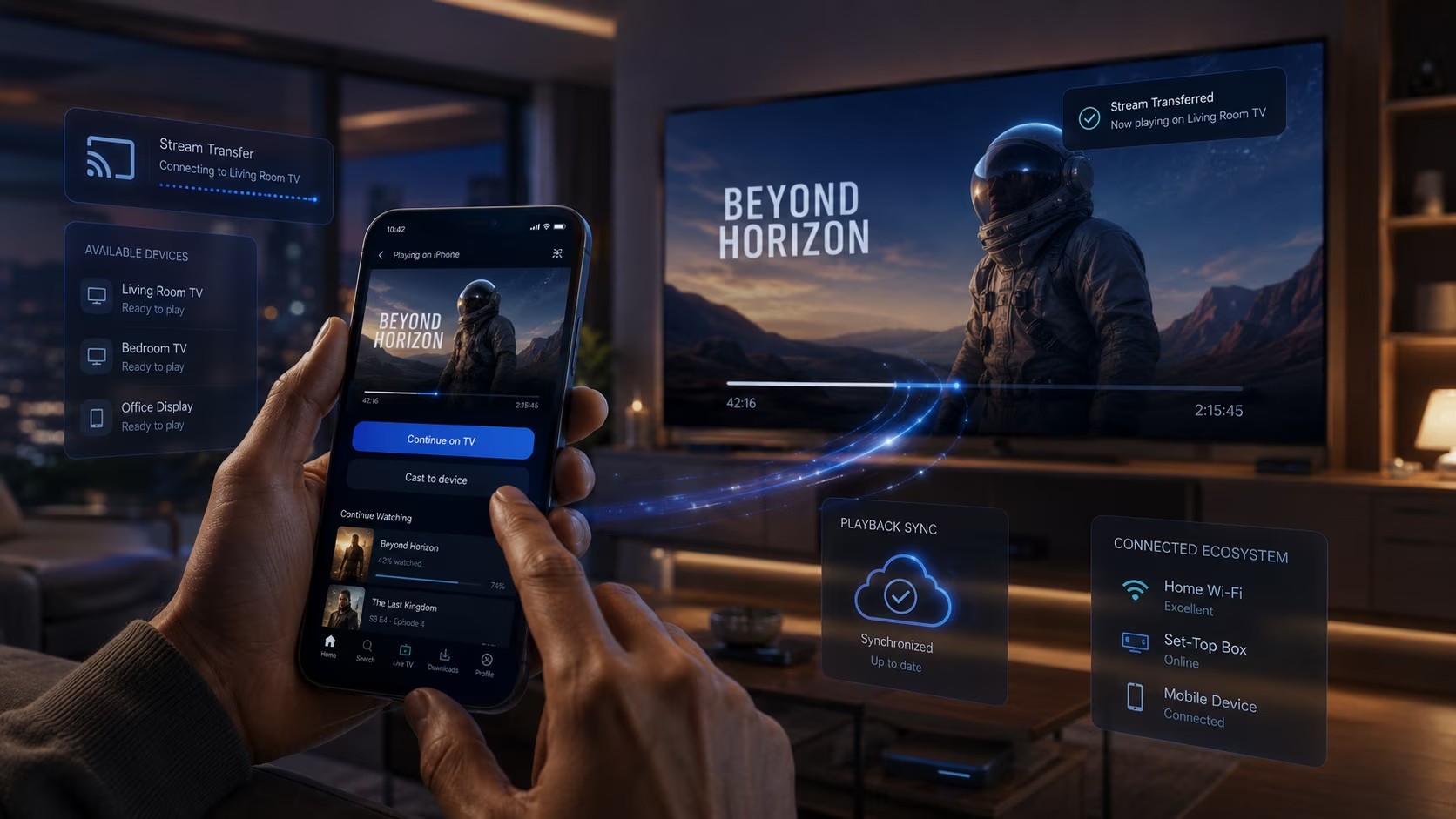
Mobile OTT operators can differentiate by making viewing continuous across devices. The customer journey often starts on the home screen TV and continues on a phone when a user leaves the room or leaves the home. It can also start on a phone and move to a television when the user wants a lean-back experience. Companion stream takeover and casting solve this with two complementary capabilities: transfer the active stream between devices, and start playback on the television from a mobile controller.
UniqCast introduces stream takeover with the uCast Companion concept, enabling users to transfer a live or on-demand stream from a mobile device to a set-top box instantly. This creates true mobility for operator TV by preserving the exact playback state and making the transition feel like a continuation rather than a restart.
In a casting model, the mobile app acts as a controller that selects content and instructs a receiver device on the home network to play it. Google Cast describes this as a sender device that initiates and controls a session while a receiver device handles playback. AirPlay similarly enables users to share video from an Apple device to Apple TV or compatible smart TVs.
Vertical shorts as the swipe-first discovery layer
Vertical shorts bring the social discovery pattern into an operator environment. Instead of relying on external platforms to shape viewing choices, the operator app can expose a swipeable feed of short clips that acts as a preview layer for the catalog. Streaming services are already introducing in-app vertical feeds to increase engagement and improve content discovery on mobile.
On the supply side, solution providers are productizing shorts creation and syndication, including the use of generative AI to identify moments and derive vertical clips from live and on-demand long-form video, then surface them through an infinite scroll experience.
Offline viewing and smart downloads designed for commuting and travel
Offline is one of the most under-monetized advantages mobile operators can own. It turns variable network reality into a controlled experience. Smart offline features also protect perceived quality, because users stop blaming the service for buffering when the service proactively adapts.
The highest-impact offline capabilities include:
- Auto-download rules based on Wi-Fi presence and user habits
- Data-aware modes that balance quality and cost
- Resume and continuity that makes downloaded content feel first-class
- Download suggestions that are tied to upcoming time windows, not just general popularity
Advertising technology that enables hybrid monetization
Hybrid monetization models are now fundamental for many operator propositions, especially when targeting mass-market mobile bases. The challenge is inserting ads without breaking quality, increasing latency, or creating inconsistent device behavior.
Two enabling elements show up repeatedly in scalable deployments:
- SCTE-35 signaling as the core cueing standard for ad breaks and program control, used across MPEG-DASH and HLS ecosystems
- Server-side ad insertion workflows that stitch ads into streams, improving consistency across devices
Security, entitlement, and anti-piracy controls
In operator OTT, security is margin protection. The most important capabilities are:
- Robust entitlement tied to operator identity
- DRM strategy aligned with device coverage
- Watermarking for premium live streams
- Anomaly detection to flag credential abuse and automated scraping patterns
Operators do not need to surpass piracy. They need to make legitimate access easier than illegal access while protecting premium rights enough to keep partnerships viable.
A measurement and experimentation layer
The final technology lever is the ability to iterate. Streaming leaders continuously test what drives playback starts and retention. Mobile operators need the same discipline, especially because they are competing for attention against social platforms and global streamers.
A commercially mature measurement layer includes:
- End-to-end QoE analytics linked to churn and customer care events
- Content funnel visibility from impression to play to completion
- Experimentation frameworks for discovery, packaging, and pricing
- Real-time live event dashboards and automated incident response playbooks
Turning Video on the Go Into a Live Events Growth Engine
Mobility is the one advantage that global streamers cannot fully replicate as a product identity. Their experiences are designed to work everywhere, on every screen, with a largely uniform interaction model. Mobile OTT operators can do something more specific and more valuable: design for the moments where the phone is the primary screen and where immediacy matters.
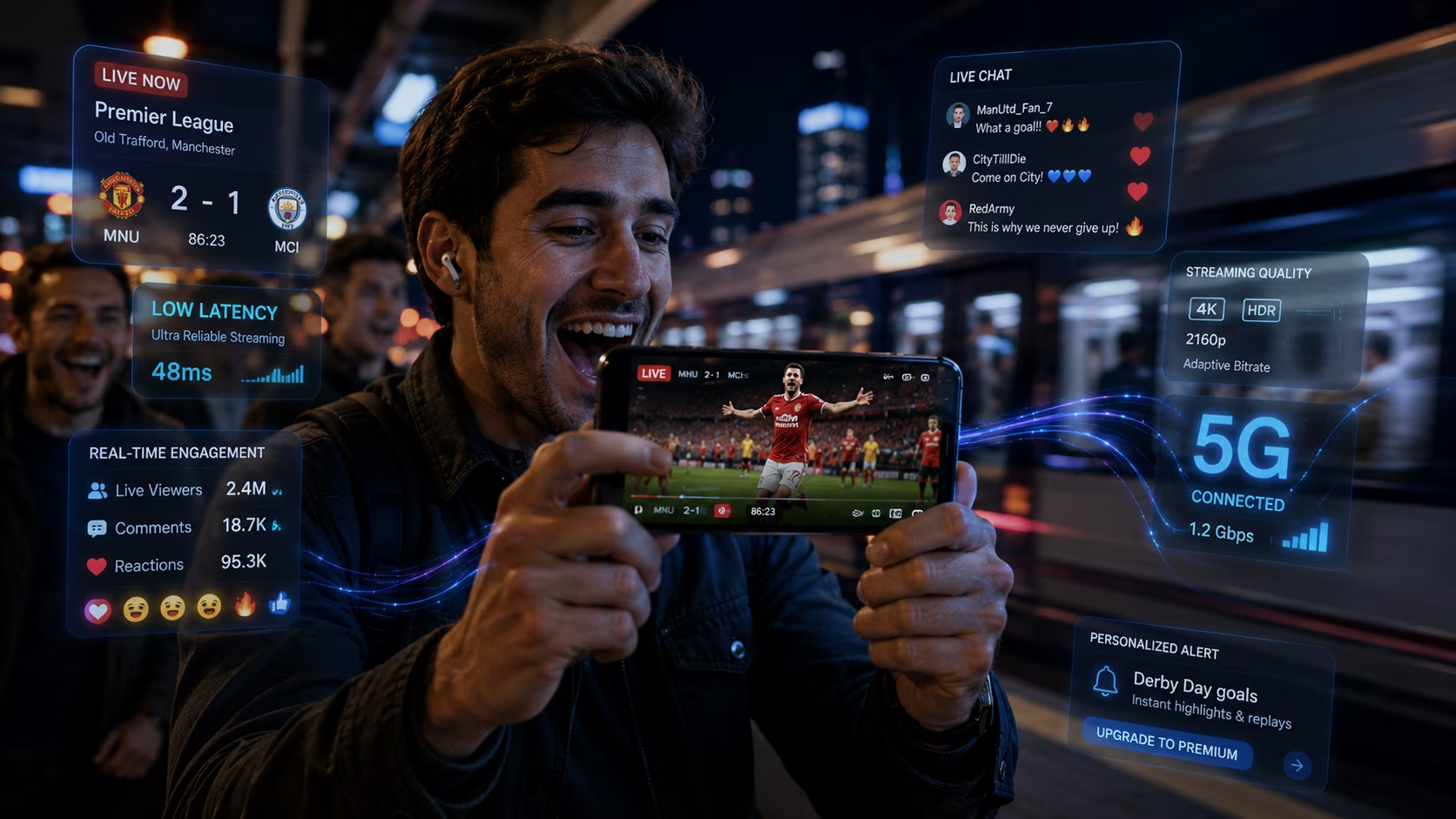
Live events are the clearest expression of this advantage. They create urgency, predictable peaks in demand, and a willingness to pay that is higher than typical on-demand viewing. They also create the strongest word-of-mouth effect when the experience is reliable and fast. For mobile operators, live events are a platform strategy that can drive plan upgrades, reduce churn, and build a brand association.
Why live events fit mobile better than any other screen
Mobile viewing is defined by context. People watch live moments while commuting, traveling, waiting, socializing, or being physically present at an event. They also watch live content as a companion screen while a household television is already in use. These are scenarios where a pure living room proposition cannot dominate.
Operators should treat these contexts as product requirements:
- Start instantly and stay stable under mobility
- Stay close to real time so the stream does not lag behind social timelines
- Make discovery and entry effortless so users can join mid-event without searching
- Make navigation fast so users can jump between feeds, highlights, and key moments
The mobile live playbook for sports
Sports is the highest-value live category for most operators, but it is also the most unforgiving. Fans abandon quickly when the stream is behind, when switching is slow, or when playback fails at peak moments. The opportunity is to build a mobile-native sports experience that feels purpose-built rather than merely televised content on a smaller screen.
A differentiated sports proposition for mobile OTT operators typically includes:
Low latency as a product promise
The closer the stream is to real time, the more valuable it feels, especially when friends are messaging, social feeds are updating, and highlights are circulating instantly.
Fast switching and instant entry
Users jump between matches, between a main feed and highlights, or between different competitions. Optimizing time-to-first-frame and switching speed is one of the highest-return investments for mobile sports.
Highlight-first navigation during live
Mobile fans often want a condensed version of the match, even while the match is live. A strong mobile sports experience surfaces:
- Key moments as they happen
- Instant replay clips
- A live highlight loop for users who join late
- Clear markers on the timeline so fans can jump to goals, penalties, or decisive plays
Multi-view and companion overlays built for a phone
Multi-view can be a differentiator when designed with mobile constraints in mind. Instead of shrinking four tiny feeds, use smart layouts that prioritize one feed and allow quick swapping. Add companion overlays such as stats, lineup changes, and win probability where rights and data access allow.
Stadium mode as a signature feature
Operators can partner with venues to create experiences for in-stadium fans who cannot always see every angle clearly:
- Alternative camera angles
- Instant replays on the phone
- Data-light mode for congested environments
- Venue-specific notifications for key moments
Stadium mode turns mobility into a feature customers can feel. It also creates a partnership surface with clubs, leagues, and sponsors.
Music, concerts, and festivals as a growth category
Concerts and festivals are inherently mobile-friendly. Audiences want to relive moments, share clips, and follow multiple artists across stages. A mobile OTT operator can build a premium experience that sits between professional broadcast and social video.
High-impact concert features include:
- Multi-stage live feeds with quick switching
- Curated highlights for each artist set
- Behind-the-scenes streams and short backstage interviews
- Fan engagement features such as polls and lightweight watch parties
- Merchandise and ticketing tie-ins through operator partnerships
The commercial advantage is that music events often enable limited-time passes and sponsorship models. They can also drive short, intense bursts of acquisition if the experience is marketed as exclusive or uniquely high quality.
Live reporting, breaking news, and real-time local relevance
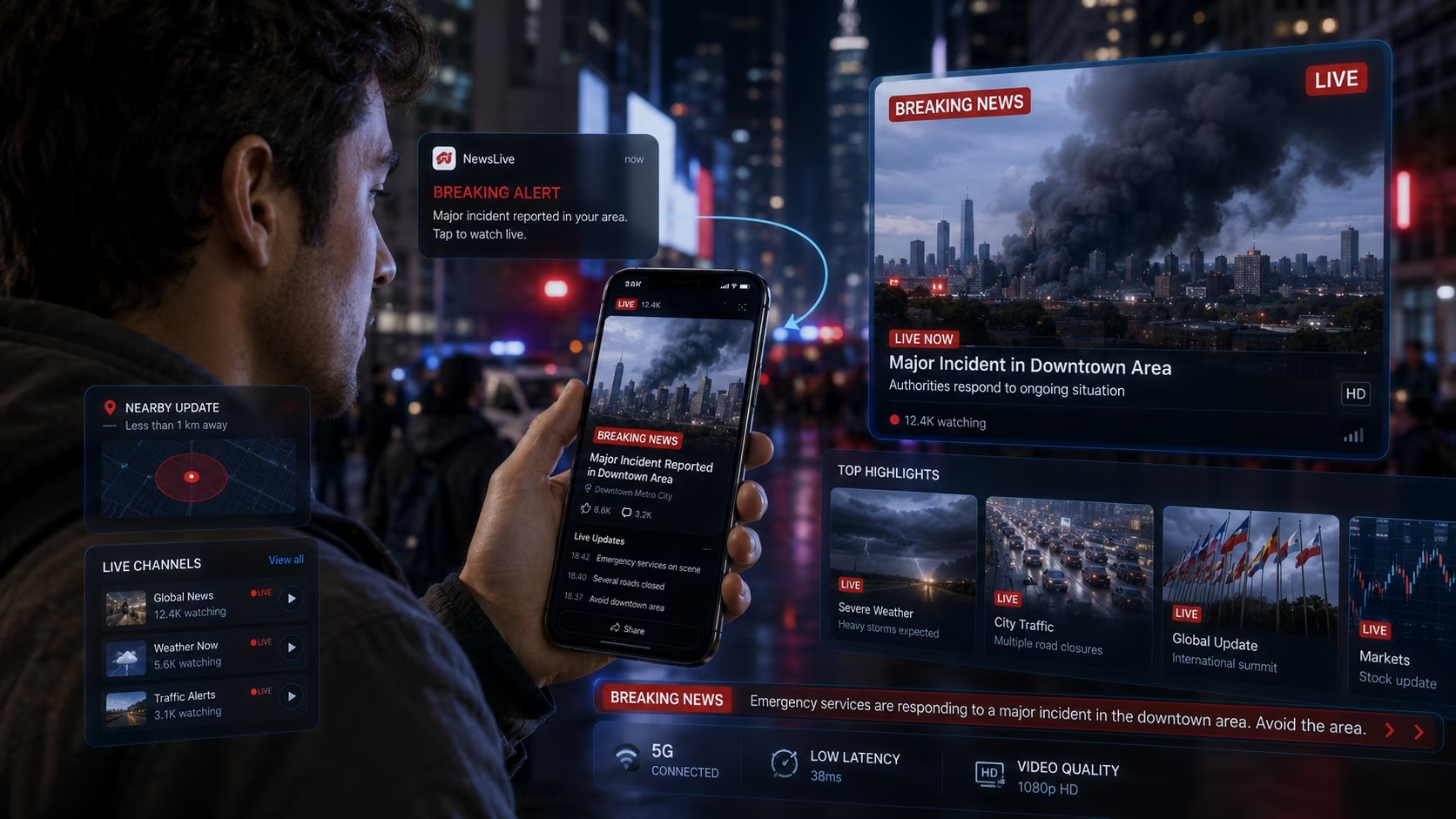
News and live reporting can be a differentiator when it is built around immediacy and context. Mobile operators can deliver strong value by combining live streams with alerts and relevance.
A mobile-first live reporting approach includes:
- Breaking alerts that link directly into live playback with minimal taps
- Pop-up live channels during major events
- Location-aware relevance for regional stories where appropriate and compliant
- A rolling highlights format for users who want a fast update rather than a full stream
This is where mobile operators can create a habit-forming relationship. Not every customer will watch full matches or full concerts, but many will return frequently for short bursts of live information.
Designing live experiences that outperform social feeds
Social video dominates smartphone viewing behavior, and that competitive baseline shapes expectations. Operators do not need to imitate social platforms, but they do need to win the first moments of attention. The goal is to make the operator service the fastest route to live value.
Practical experience design principles include:
- A dedicated live entry point that always shows what is happening now
- Personalized live rails based on teams, artists, leagues, or topics
- A join-in-progress design that makes it easy to start mid-event
- A highlights layer that is visible without leaving the live environment
- A clear promise on latency and reliability, reinforced through product messaging
Monetization models built around live moments
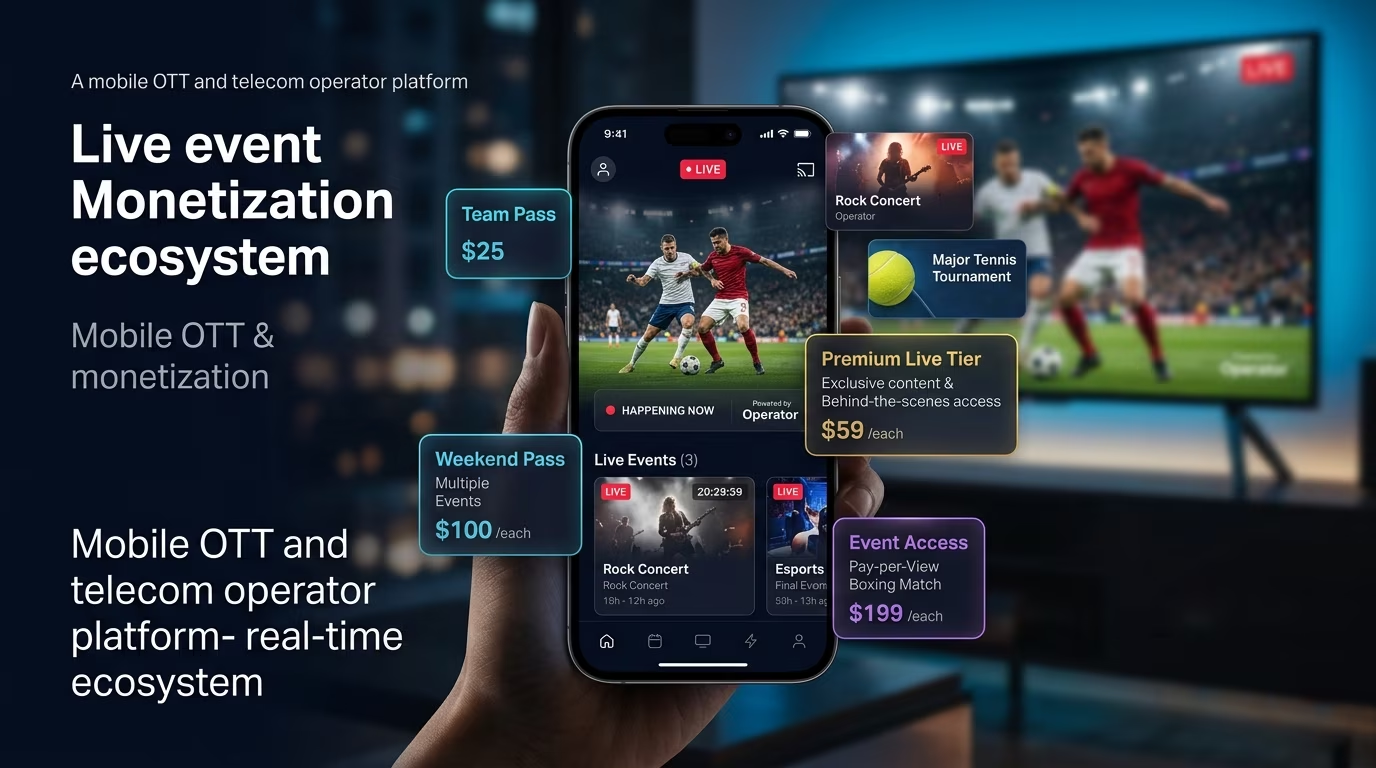
Live events open monetization options that are difficult to execute with on-demand libraries alone. Mobile operators can combine several models without confusing customers, as long as packaging is simple.
Common live event monetization options include:
- Team passes and tournament passes for sports
- Weekend passes and pay-per-event models for major fights, concerts, or special events
- Premium live tiers with higher quality, better reliability, and exclusive angles
- Sponsorship and brand integrations for free-to-view live windows
- Bundled data offers tied to event viewing, within regulatory and net neutrality constraints
The most important commercial principle is that live should be treated as a product line with its own pricing logic, lifecycle marketing, and retention plan.
Final Thoughts

Part 3 makes it clear that the most effective mobile OTT operators will be those that build stacks designed around real user behavior: short sessions, live moments, on-the-go viewing, variable network conditions, and rising expectations for simplicity and speed. In that context, capabilities such as low-latency delivery, AI-powered discovery, dynamic merchandising, stream takeover, and offline continuity are core drivers of perceived value, retention, and revenue.
What stands out most is that the real opportunity lies in combining these capabilities into experiences global streamers are not naturally built to own. Mobile operators can connect network intelligence, identity, billing, live event delivery, and device continuity into one coherent service layer that feels purpose-built for everyday mobile life. That is especially powerful in live environments, where immediacy, reliability, and contextual relevance matter most. The operators that win will have a sharper stack, built around moments that matter and engineered to make mobile TV feel indispensable.