

Competing and Winning in the Mobile OTT Market
The Mobile TV Playbook, Part 2
This article is Part 2 of a broader series based on the whitepaper The Mobile TV Playbook, which explores how mobile operators can build, position, and grow successful OTT video services in an increasingly fragmented streaming landscape.
You can download the full whitepaper here:
In this second part, the focus shifts from market definition to competitive reality. Mobile OTT operators are not only competing with global streaming brands, but also with social video platforms, local broadcasters, direct-to-consumer sports services, device ecosystems, and even piracy. At the same time, they must navigate churn, content fragmentation, monetization pressure, discovery challenges, and rising quality expectations. Yet despite these pressures, mobile operators also hold meaningful advantages in distribution, billing, identity, network proximity, and local market relevance. The key question is: how they can differentiate in a way global streamers cannot easily replicate.
Competitive Landscape
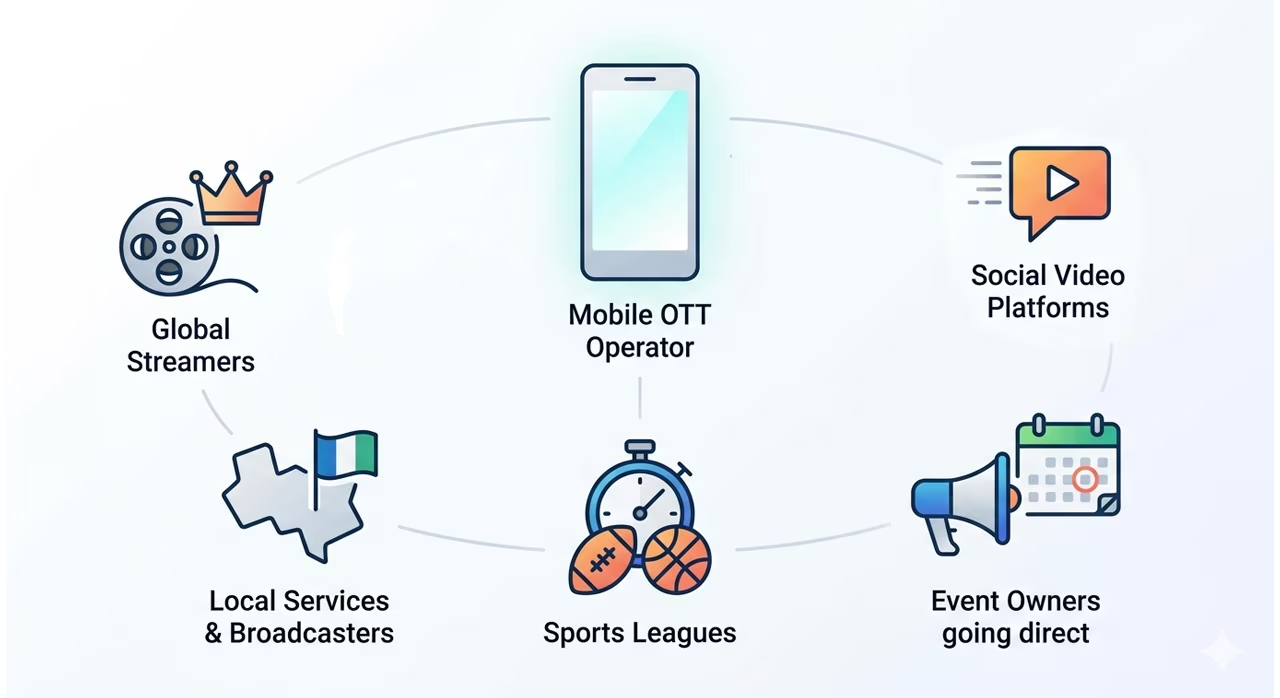
Mobile OTT operators face competition on multiple fronts. Global streamers set the benchmark for product polish and premium branding. Social video platforms compete for daily attention through frictionless discovery. Local services and broadcasters win through cultural relevance and specialized rights. Sports leagues and event owners increasingly go direct, fragmenting rights and increasing churn cycles.
Global subscription video platforms set the benchmark for experience and brand
Netflix, Disney Plus, Prime Video, Max, and other global subscription platforms compete on a combination of brand, original programming, and product polish. Even when customers do not subscribe continuously, these services define what users expect from a premium experience: instant start, stable streaming, seamless resume across devices, predictable recommendations, and consistent personalization.
They also shape price sensitivity and churn behavior across the entire market. Deloitte’s 2025 reporting shows how fluid subscriptions have become: 39 percent of consumers churned from at least one paid subscription video service in the last six months, and Gen Z churn was even higher at 54 percent. Deloitte also reports rising dissatisfaction with value, including that 47 percent of surveyed consumers feel they pay too much for streaming services, and that a five dollar price increase would make 60 percent likely to cancel their favorite service.
Implication for mobile operators: you are competing against a premium expectation set by global leaders, in a market where users have learned to subscribe, cancel, and return quickly. Loyalty must be earned through convenience, relevance, and bundled value.
Social video platforms are the primary competitor for time on smartphones
On mobile, the largest competitor for attention is not another subscription service. It is short-form, algorithm driven social video. Ericsson analysis shows that social media generated videos constitute 70 to 80 percent of mobile video traffic viewed on smartphones, while streaming video on demand services represent less than 10 percent.
This reshapes the competition. Global subscription platforms compete for budget and evening viewing. Social platforms compete for the most scarce resource: daily minutes and habitual engagement. Their advantage is frictionless discovery and a feed that constantly adapts to intent.
Implication for mobile operators: a mobile OTT experience cannot rely on catalogue depth alone. The home screen must be designed to beat scrolling. Discovery must feel instantaneous, personalized, and tuned for short sessions, especially for live highlights and bite-sized content.
Local and broadcaster streaming services own cultural relevance
In many regions, local streaming services and broadcaster direct offers have a stronger emotional pull than global platforms. They own local language storytelling, familiar talent, and domestic sports and entertainment. Even when they lack global scale, they win through relevance and habitual viewing.
This category matters because it increases fragmentation. Customers accumulate multiple niche services, then churn and rotate based on what is currently available. The more fragmented the market, the more valuable an operator becomes as an aggregator and guide, but only if the operator can unify discovery and billing across that fragmentation.
Implication for mobile operators: a successful mobile OTT operator either secures strong local content anchors or becomes the best distribution and discovery layer for local services.
Sports leagues, federations, and event owners are now direct rivals
Sports and major live events increasingly drive subscription spikes, churn cycles, and platform switching. Kantar’s reporting highlights sports content as a key driver of streaming sign-ups in the United States in late 2024, reinforcing that live rights are now a primary acquisition lever. At the same time, rights packaging is becoming more complex, with different matches and competitions landing across different services. A recent example is the United Kingdom Champions League rights deal for 2027 to 2031, which increased in value and involves multiple platforms, reinforcing the direction toward fragmentation for fans.
For mobile OTT operators, sports is both a threat and an opportunity. It is a threat because it inflates rights costs and can force customers into multiple subscriptions. It is an opportunity because mobile is the natural home for live engagement in the moment, including out-of-home viewing, highlights, and second screen experiences.
Implication for mobile operators: do not treat sports only as a content category. Treat it as a product system that includes low-latency delivery, instant highlights, personalization around teams, and event driven passes. Operators can win even without owning the largest rights set by becoming the best mobile experience for live moments.
Device ecosystems and app stores are gatekeepers in the mobile OTT journey
Mobile OTT operators build on platforms they do not fully control: phone operating systems, app stores, device hardware, and sometimes casting ecosystems. These gatekeepers shape acquisition funnels, subscription flows, and user experience constraints. The competitive reality is that a large part of the customer journey is mediated by devices and operating systems that were not designed around operator priorities.
Implication for mobile operators: differentiation must happen inside the experience layer you control. That means better onboarding, stronger identity and entitlement, consistent playback, and superior discovery. It also means planning for multi-device continuity because mobile viewing often starts on a phone and continues elsewhere.
What this landscape means for mobile OTT strategy
This competitive map leads to a clear conclusion: mobile operators are not simply launching an app. They are entering an attention economy where global streamers define quality, social platforms dominate daily minutes, sports drives switching behavior, local services fragment rights, device ecosystems shape journeys, and piracy competes on aggregation.
To compete effectively, mobile OTT operators must prioritize three forms of differentiation that align with their unique strengths:
- Win the daily habit through discovery and speed. Mobile-first personalization and session aware recommendations are required to compete with scrolling behavior.
- Win the wallet through bundling and simplicity. In a high-churn market, value must be packaged into plans and bundles that feel easier than managing multiple direct subscriptions.
- Win the moment through live and mobility. Live sports and events are increasingly decisive. Operators can use mobility and network grade delivery strategies to make live viewing on the go a premium experience.
Key Challenges for Mobile OTT Operators
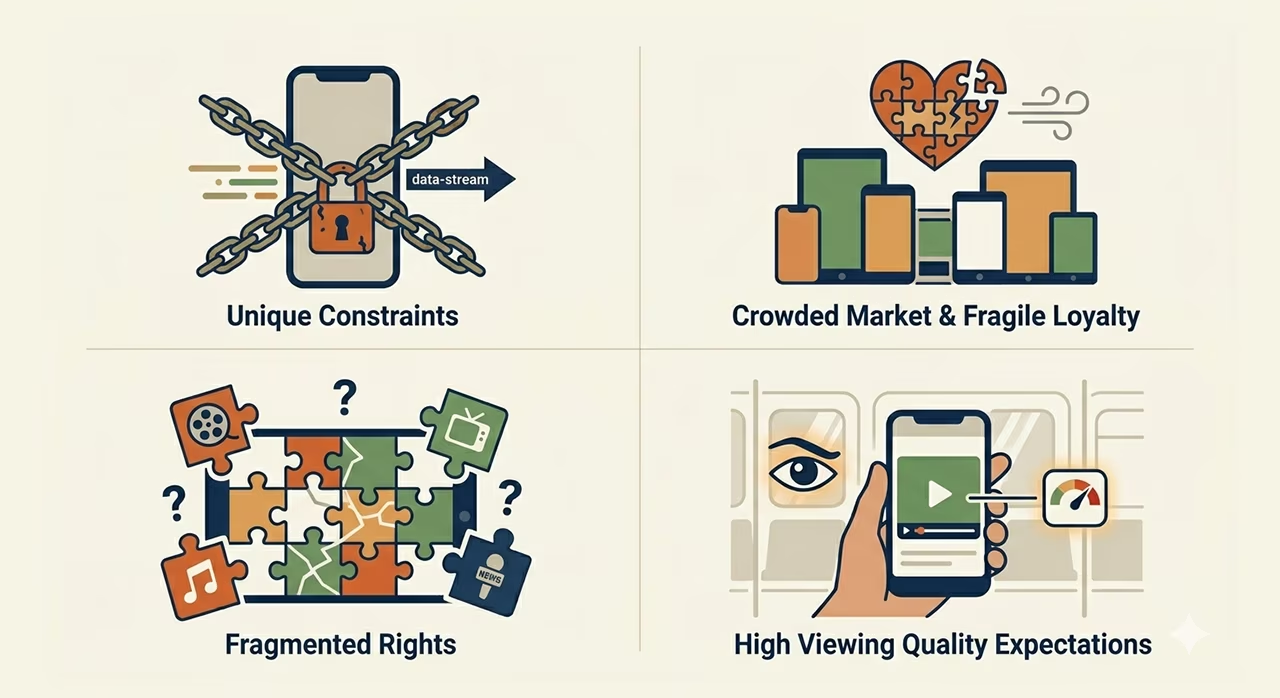
Mobile operators enter OTT with real structural advantages, but they also inherit a unique mix of constraints that pure OTT players do not face. The market is crowded, consumer loyalty is fragile, rights are fragmented, and mobile viewing amplifies quality expectations because every failure is experienced personally, immediately, and often in a context where the user has little patience.
Churn is not a risk. It is the default behavior
The streaming economy has trained consumers to subscribe, cancel, and return with minimal friction. Deloitte reporting from 2025 shows that 39 percent of consumers cancelled at least one paid streaming video service in the last six months, with Gen Z reaching 54 percent.
For mobile OTT operators, this creates two immediate pressures:
- Retention cannot rely on a catalogue promise alone. You must build daily relevance and plan value that makes leaving feel inconvenient.
- The product must support churn dynamics without destroying margin. Win back journeys, flexible bundles, and event driven offers need to be engineered in advance, not added later.
Content fragmentation multiplies cost and weakens the customer promise
Fragmentation is now the defining feature of premium video. The rights that customers care about most, especially sports and premium series, are spread across multiple services. This creates a structural challenge for any operator OTT offer that tries to look like a complete destination.
Operators face three related problems:
- Customers blame the operator for missing content, even when the rights market makes it impossible to carry everything.
- The more fragmented the market becomes, the more the customer’s default expectation shifts toward aggregation, unified search, and consolidated billing.
- Fragmentation fuels piracy and illegal aggregation because unlicensed services compete on a single promise, everything in one place. MUSO reports that TV piracy remained the largest category in 2024 with 96.8 billion visits.
The strategic implication is clear. If you cannot own the breadth of rights, you must own the convenience layer. Super-aggregation, unified discovery, and clear packaging become core to the value proposition.
Content rights economics can break the business case
Premium rights, especially for sports, have become both an acquisition magnet and a financial trap. Operators that chase exclusivity without distribution reach, partner support, and a credible retention plan can end up with high fixed costs and insufficient monetization.
The DAZN dispute around Belgian Pro League rights illustrates how distribution constraints and partner agreements can become existential when a service relies heavily on direct app distribution and cannot secure broad carriage partnerships.
For mobile OTT operators, this translates into a practical rule. Live rights require an integrated plan across distribution, marketing, packaging, and delivery quality. Content alone does not create value if the service cannot reach the right audience at scale.
Mobile quality of experience is a product issue, not only a network issue
Mobile streaming happens under variable conditions: handovers, congestion, device limitations, and unpredictable viewing contexts. This makes quality of experience, known as QoE, one of the most decisive drivers of satisfaction and churn.
Startup delay is especially punishing. Akamai research shows that viewers begin to abandon video when startup delay exceeds about two seconds, and that beyond that point each additional second of delay is associated with a substantial increase in abandonment.
Mobile OTT operators therefore face a dual challenge:
- Engineering for speed and resilience across networks and devices
- Managing customer perception, because users attribute failures to the operator brand even when issues originate from third-party app behavior, device constraints, or content partner delivery
This is why operational capabilities such as real-time monitoring, incident response, multi-CDN strategies, and playback optimization are critical for successful mobile TV business. It is also important to have streaming that is robust, resilient to variable network conditions, and capable of resuming playback from the same point once network conditions are restored.
Discovery has become a competitive battleground
Catalogue scale no longer guarantees engagement. The market has reached a point where customers feel overloaded, and the simplest alternative is to leave the app and scroll elsewhere. If users do not immediately see value, they will cancel and rotate.
Mobile operators must solve discovery at three levels:
- Personalization that adapts to short sessions and intent
- Search that understands context and natural language, not just exact titles
- Cross-service discovery, because customers increasingly consume content across multiple partner apps and packages
If discovery is weak, super-aggregation becomes only a billing consolidation tool rather than an engagement engine.
Partner complexity increases
Many mobile OTT strategies depend on a growing ecosystem of streaming partners, content providers, technology vendors, ad platforms, and analytics tools. Each additional partner introduces entitlement complexity, reporting disputes, customer care friction, and release coordination challenges.
Common pain points include:
- Inconsistent metadata and inconsistent categorization across partners, which undermines unified search and recommendations
- Conflicting commercial priorities around promotion placement and bundling terms
- Limited visibility into engagement when viewing occurs inside partner apps rather than the operator experience
Omdia’s tracking of thousands of telco and online video distribution partnerships highlights how large the bundling ecosystem has become, and why operators need platform-level commonality to scale efficiently.
Monetization is under pressure
Subscription-only economics are increasingly difficult, especially for offers targeting mass market mobile bases. Price sensitivity and subscription fatigue push customers toward flexible and lower-cost options, which forces operators to diversify monetization.
For mobile OTT operators this typically means combining:
- Subscription tiers for premium value
- Advertising supported layers such as FAST channels and hybrid tiers
- Transactional models for events, sports passes, and limited-time access
The challenge is operational. Advertising introduces measurement, ad decisioning, brand safety, and sales execution complexity. Event monetization introduces peaks, scale planning, and elevated customer support requirements. None of these are impossible, but they must be designed into the operating model from day one.
Piracy competes directly with the operator promise of convenience
Piracy is not only about price. It is about access, timing, and aggregation. MUSO tracked 216.3 billion visits to piracy sites in 2024, and TV piracy alone reached 96.8 billion visits. This level of demand exists in every region and will surface whenever legal experiences feel fragmented, expensive, or hard to access.
For mobile OTT operators, the practical challenge is to outcompete piracy on convenience:
- Offer unified discovery across services
- Make activation and payment frictionless
- Ensure reliable playback and strong customer support
- Reduce the need for multiple subscriptions through smart bundles and passes
Organizational readiness can be the hidden constraint
Finally, mobile OTT is a continuous product discipline. Operators used to network release cycles and traditional service management must build capabilities closer to modern digital product organizations: rapid experimentation, UX iteration, data science, content operations, and growth marketing.
Without this shift, operators tend to launch a service and then struggle to evolve it at the pace the market demands. The result is predictable: the product becomes a bundle add-on rather than a differentiated service that customers actively choose.
What these challenges imply for mobile TV operators
These challenges point toward a consistent strategic direction:
- Compete on convenience and discovery rather than trying to outspend global platforms on originals
- Use super-aggregation and unified experiences to turn fragmentation into an operator advantage
- Treat QoE and low-latency live delivery as core brand promises
- Build monetization beyond subscriptions, aligned with mobile behaviors and event moments
- Design an operating model that can execute continuous improvement
Strengths of Mobile OTT Providers
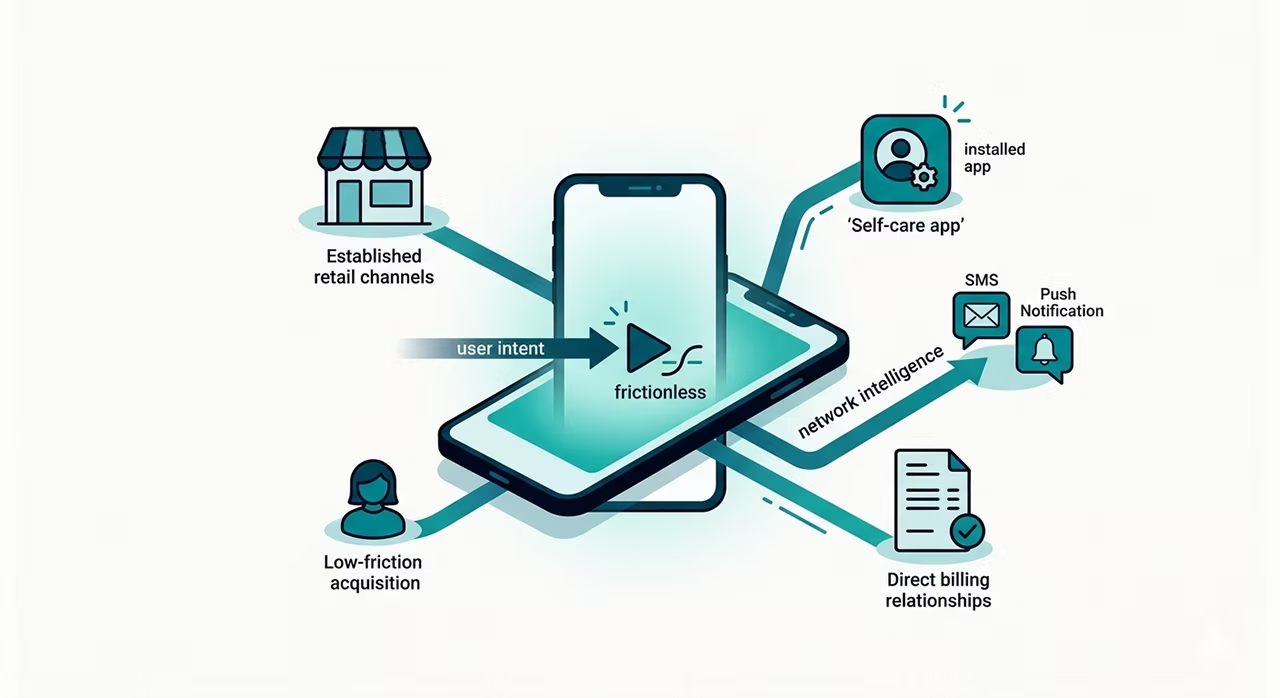
Mobile OTT operators do not need to win by copying the playbook of global streamers. They can win by leaning into assets that pure OTT platforms rarely control at scale: distribution, billing, identity, network intelligence, and a daily customer relationship that extends beyond entertainment.
Mass distribution and low-friction acquisition
Mobile operators already operate at consumer scale with established retail and digital channels, installed self-care apps, and direct communication paths such as SMS, push notifications, and in-app messaging. That reach turns marketing from an external spend into an internal capability.
This creates three advantages:
- Lower acquisition cost through owned channels
- Faster activation through existing customer journeys
- Stronger conversion through contextual offers tied to plan upgrades, roaming, device refresh, and loyalty milestones
For OTT, distribution is about reducing the number of steps between intent and playback. On mobile, where the alternative is one tap away, this friction reduction can be the difference between a trial that converts and a trial that churns.
Billing and bundled value, one of the hardest advantages to replicate
Carrier billing and plan integration remain underappreciated strategic assets. Operators can offer subscription activation that does not require a card, which is critical in markets with lower card penetration and in prepaid-heavy ecosystems. Even in mature card markets, billing through the operator can simplify subscription management and reduce churn drivers linked to failed payments.
Bundling also allows operators to redefine value. Instead of competing purely on catalogue breadth, operators can compete on total plan value:
- Entertainment bundled into tiered plans
- Family propositions that combine data, devices, and video
- Seasonal and event-driven passes attached to plan upgrades
- Loyalty-driven perks and discounts that reward tenure
This directly addresses subscription fatigue by shifting the customer question from “which services should I keep” to “what plan should I be on”.
Identity, entitlement, and trust at scale
Mobile operators have verified identities, SIM-based authentication options, and established entitlement systems. This simplifies login, enables consistent account management, and reduces customer friction across devices and services.
More importantly, it enables trust. Customers are accustomed to receiving critical services from their operator. When the OTT service is integrated into the operator identity layer, the customer experience can feel more reliable than managing multiple standalone subscriptions.
Identity strength also supports practical controls that help protect content value:
- Device management and profile governance
- Fraud reduction and entitlement validation
- Account recovery and support flows that are simpler than many pure OTT providers
This is about making the service easier to use while protecting commercial terms in a world of widespread credential sharing.
Network proximity and quality advantage
Mobile OTT operators can influence video quality in ways pure OTT platforms often cannot, because operators sit closer to the delivery layer. Even when they cannot control every part of the internet path, operators can still use multi-CDN strategies, edge caching, traffic engineering, and real-time telemetry to improve resilience and reduce buffering.
This matters because mobile viewing is unforgiving. Customers blame the service provider when playback fails, regardless of root cause. A credible mobile OTT proposition therefore must treat quality as a brand promise, not a backend metric.
Operators that use their network advantage effectively can differentiate with:
- Faster start times and smoother adaptation under mobility
- More stable playback during congestion spikes
- Event-ready delivery for major live moments
Mobility as a unique experience advantage
Mobility is the ability to deliver relevant video experiences in moments that fixed OTT services do not fully own: commuting, waiting, travel, out-of-home social settings, and live events.
This is where mobile operators can turn their defining characteristic into a differentiated proposition:
- Live sports that works reliably outside the home
- Concerts and festivals designed for in-the-moment viewing
- Breaking news and live reporting with immediate access and notifications
- Contextual discovery that adapts to the customer’s time window and location patterns
This advantage becomes stronger when paired with low latency delivery, rapid stream switching, highlights, and intent-based recommendations that assume short sessions and frequent interruptions.
Data insights and personalization potential
Operators have broad signals across the customer lifecycle: device type, plan tier, tenure, roaming behavior, engagement with self-care channels, and customer care interactions. Used responsibly and in compliance with privacy regulations, these signals can improve the OTT experience and commercial performance.
Examples include:
- Predictive churn models that trigger retention offers tied to content preferences
- Personalized bundles that match viewing behavior and price sensitivity
- Smarter upsell journeys based on demonstrated engagement with live sports, kids content, or downloads
This is also where the mobile operator can outperform many pure OTT services on relevance, because the operator relationship is not limited to content interactions.
Local relevance and partnership leverage
Global streamers scale globally. Operators win locally. They understand local payment habits, language requirements, regulatory realities, and regional content taste. This makes operators strong partners for local broadcasters, sports rights holders, and niche content providers seeking distribution.
In many regions, operator distribution already plays a meaningful role in streaming adoption through bundles and indirect subscriptions. Operators can convert that distribution strength into a differentiated super-aggregation proposition that helps users navigate fragmentation rather than suffer from it.
Customer care and service assurance
In OTT, customer care is often heavily automated. Operators already run large-scale support organizations and service assurance practices. When executed well, this can become a trust advantage, especially for live events where failures trigger immediate dissatisfaction.
The goal is not to replicate telecom support structures inside the OTT product. The goal is to apply service assurance discipline to streaming:
- Real-time incident visibility and proactive communication
- Clear ownership across operator services and partner services
- Compensation policies that protect trust when failures occur
Advertising and monetization channels that extend beyond the app
Many operators have existing advertising businesses, enterprise relationships, and local sales reach. This can support monetization paths that pure OTT players struggle to execute in local markets, especially for hybrid models that include FAST channels and advertising-supported tiers.
The operator advantage here is the ability to package sponsorships and advertising into broader commercial relationships, including sports events, music partnerships, and location-based campaigns, while maintaining a premium tier for subscription customers.
Turning strengths into a coherent OTT strategy
These strengths only matter if they are converted into a customer promise that is clear and defensible. The strongest mobile OTT strategies typically anchor on three operator-native differentiators:
- Convenience through bundling, billing, and super-aggregation
- Quality through delivery excellence and live readiness
- Mobility through live moments, contextual discovery, and on-the-go design
How Mobile OTT Operators Compete With Global Streamers

The most dangerous mistake a mobile OTT operator can make is to believe the primary competition is a better content library. Global platforms win when the game is defined by blockbuster originals and worldwide brand pull. Mobile operators win when the game is defined by convenience, relevance, live moments, and distribution leverage. The objective of differentiation is not to become the next Netflix. The objective is to become the service layer that customers use every day because it simplifies their streaming life and performs best in mobile contexts.
The biggest threats facing mobile OTT operators
Attention is being absorbed by social video
On smartphones, social platform video dominates viewing behavior. Ericsson reports that social media generated video accounts for 70 to 80 percent of smartphone video traffic, while video on demand streaming services represent less than 10 percent. This is a direct threat to engagement. Even a well-priced OTT offer can fail if customers do not open it frequently enough to form habits.
What this means in practice is that the first competitor is not a subscription service. The first competitor is scrolling.
Churn and subscription fatigue are now structural
Streaming customers behave like traders, not loyalists. Deloitte reports that 39 percent of consumers canceled at least one paid SVOD service in the last six months, and Gen Z churn reached 54 percent. This churn reality makes growth expensive and makes content investment harder to monetize over time.
For mobile OTT operators, churn is a threat in two directions. Customers churn from your service, and customers churn from partner services you distribute, which can weaken bundle economics and reduce perceived value.
Content fragmentation pushes users toward convenience winners
Rights are spread across many services and customers increasingly want one place to discover and manage everything. Omdia estimates that 365 million SVOD subscriptions are distributed through operator TV, broadband, and mobile bundles in 2024, representing 20 percent of the global streaming market, and projects bundling to reach 540 million subscriptions by 2029, representing 25 percent. This confirms a structural shift: distribution and aggregation are becoming primary channels for streaming growth.
The threat is losing the experience layer to someone else who aggregates better.
Quality expectations keep rising while mobile conditions remain variable
Video is forecast to account for 76 percent of all mobile data traffic by the end of 2025. As video becomes the dominant traffic type, customers also become less tolerant of friction. On mobile, delays and failures are more likely to be blamed on the operator brand, even if causes are outside the operator’s direct control.
Disintermediation by global platforms
Global platforms increasingly want direct relationships, direct billing, and direct data. At the same time, device ecosystems and app stores influence discovery and subscription flows. The operator that does not own its customer experience becomes a pass-through channel with limited leverage over margin and churn.
A differentiation framework that works against Netflix-like platforms
To compete effectively, mobile OTT operators should define their strategy around three questions. What job does the service do for the customer? Why is the operator uniquely qualified to do that job? What is difficult for a global streamer to replicate?
A strong differentiation framework typically includes four pillars.
Pillar 1: Become the super-aggregator that reduces streaming effort
If fragmentation is the market reality, aggregation is the natural operator play. The goal is to reduce the total cognitive load of streaming.
A credible super-aggregation proposition includes:
- Unified discovery across operator content and partner services
- Unified identity and entitlement so users do not repeatedly log in
- Unified billing and plan integration so subscriptions feel like part of the mobile relationship
- A single place to manage, pause, resume, and upgrade subscriptions
- Local SVOD content and local live channels
What global streamers struggle to replicate is neutrality. They can promote their own library. They cannot easily become the trusted guide across competing services at scale.
Pillar 2: Build a discovery engine designed for mobile intent and short sessions
Because social video dominates smartphone attention, discovery must be engineered to win the first ten seconds. The customer is used to content being served instantly and continuously.
Mobile OTT operators can differentiate by building discovery that is:
- Session-aware, offering quick picks for five minutes, ten minutes, and thirty minutes
- Moment-aware, highlighting what is live now, what is trending locally, and what is newly available in the customer’s bundles
- Context-aware, integrating downloads and offline recommendations for commuting and travel behavior
- Cross-service, surfacing results from partner apps and operator catalogues in one search and one recommendations layer
This is where AI-based personalization becomes commercially decisive. It reduces churn by making value visible immediately.
Pillar 3: Own live and mobility as a premium experience category
Netflix-like platforms are strong for lean-back on-demand viewing. Mobile operators can be strongest where mobility matters most: local live channels, live sports, concerts, festivals, breaking news, and out-of-home viewing.
Differentiation here requires more than rights. It requires experience design:
- Low-latency delivery and rapid stream switching for live events
- Instant highlights and key-moment navigation during live playback
- Multi-view and companion features that fit mobile behavior
- Event passes and short-term products designed around real viewing occasions
Global streamers can do live, but mobile operators can integrate live into the network relationship, the plan, the notifications layer, and the customer lifecycle in a way global platforms typically cannot.
Pillar 4: Compete on value packaging, not only on price
Churn data shows customers are willing to cancel quickly. Operators can reduce this by making streaming value part of a broader relationship, where leaving the OTT service means losing more than a single subscription.
Value packaging levers include:
- Bundles attached to plan tiers, including family plans and device financing
- Flexible add-ons such as sports weekends and tournament passes
- Subscription management that supports temporary downgrades rather than full cancellation
- Loyalty integration that rewards tenure with upgrades, premium features, or partner rotations
The operator advantage is that packaging can be anchored to services customers already pay for and use daily.
What success looks like
A differentiated mobile OTT operator is judged by whether it becomes the simplest way to access and manage streaming, the best way to watch live on the go, and the most relevant experience on a phone in daily moments.
If you do that well, global streamers become partners as often as they are competitors, because the operator becomes the route to market, the retention layer, and the experience surface where customers decide what to watch next.
Final Thoughts
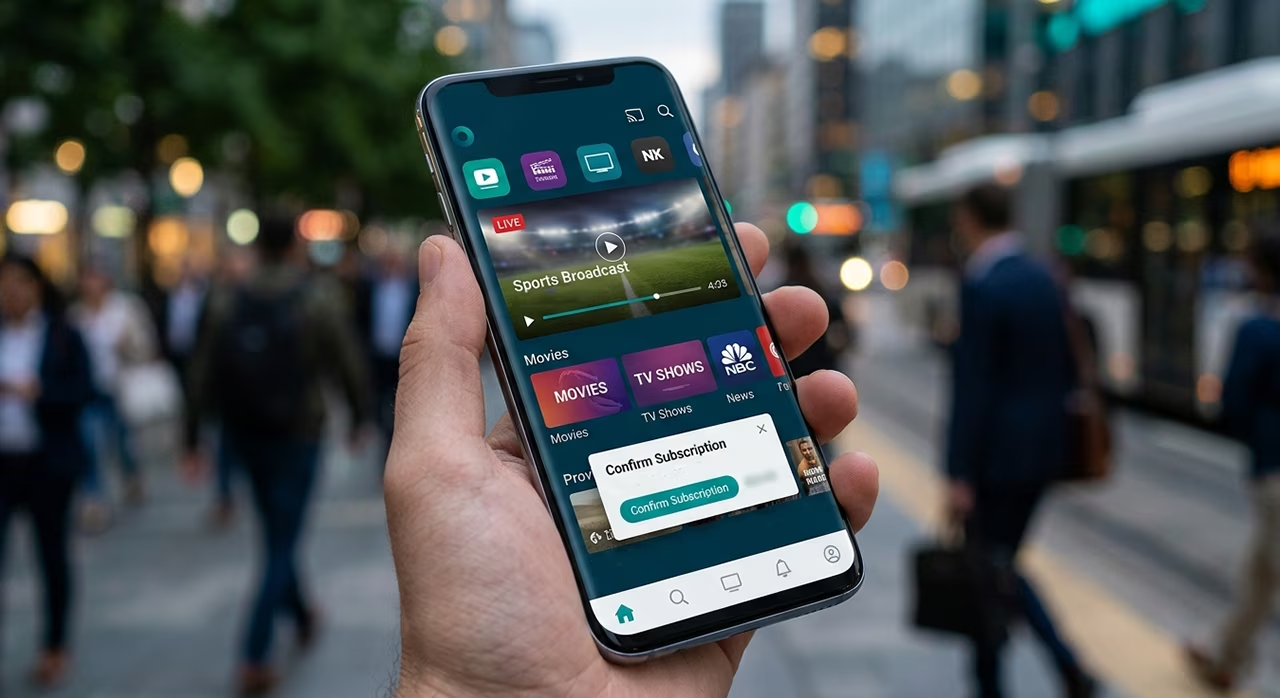
Part 2 makes it clear that success in mobile OTT will not come from trying to outspend or outscale global streaming platforms. The competitive environment is too fragmented, attention is too contested, and customer loyalty is too fragile for that strategy to hold. Instead, the strongest mobile OTT operators will be the ones that turn market complexity into customer simplicity by combining content access, unified discovery, frictionless billing, and strong mobile-first experiences into one coherent service promise.
What emerges from this analysis is a practical strategic direction. Mobile operators are best positioned to win when they focus on super-aggregation, mobile-native discovery, live and on-the-go viewing, and value packaging that fits naturally into the broader customer relationship. Their edge is solving problems that global OTT platforms are not built to solve as effectively: reducing streaming effort, improving everyday convenience, and delivering live moments reliably in mobile contexts. In that sense, mobile OTT is a chance for operators to become the service layer that helps customers navigate a more fragmented entertainment world.