
The State of Video Services in APAC: What Actually Works (and Why)
Quick Summary
The State of Video Services in APAC: What Actually Works (and Why)
APAC is often described as the fastest-growing video market in the world.
That’s true, but it only tells part of the story.
For telcos, ISPs, mobile operators, and DVB providers, APAC isn’t one market. It’s a collection of vastly different network conditions, device habits, price sensitivities and content expectations, where strategies that work in one country can fail completely in another.
Some operators are solving for scale with razor-thin margins. Others are optimizing premium experiences in highly competitive environments. And many are trying to evolve legacy platforms while still serving millions of users.
This is why video success in APAC is defined by building a service that can adapt to local content demand, mobile-first viewing, legacy infrastructure, hybrid monetization, and constantly changing user behavior.
Yet across all this diversity, clear patterns are emerging. Operators that succeed are the ones that aggregate better, personalize smarter, monetize more flexibly, and modernize their platforms without disrupting existing subscribers. Also, one thing is clear:
The opportunity for success is massive and still expanding.
Southeast Asia alone represents one of the most dynamic video growth regions, driven by mobile-first audiences, rising broadband adoption, expanding digital payments, and strong demand for local and regional content. At the same time, more mature APAC markets such as Japan, South Korea, Australia, and Singapore show a different pattern, where competition is shaped by premium content, advanced broadband infrastructure, sophisticated user expectations, and high-quality multiscreen experiences.
According to long-term projections from MARC Group, the Southeast Asian OTT market alone is expected to reach $139 billion by 2033, growing at a 23% CAGR. At the same time, data from Media Partners Asia shows that APAC already accounts for nearly 35% of global OTT revenue.
For video operators, this isn’t just growth. It is a service design challenge. Operators need platforms that can scale across diverse markets while still feeling local, affordable, reliable, and relevant to each subscriber segment.
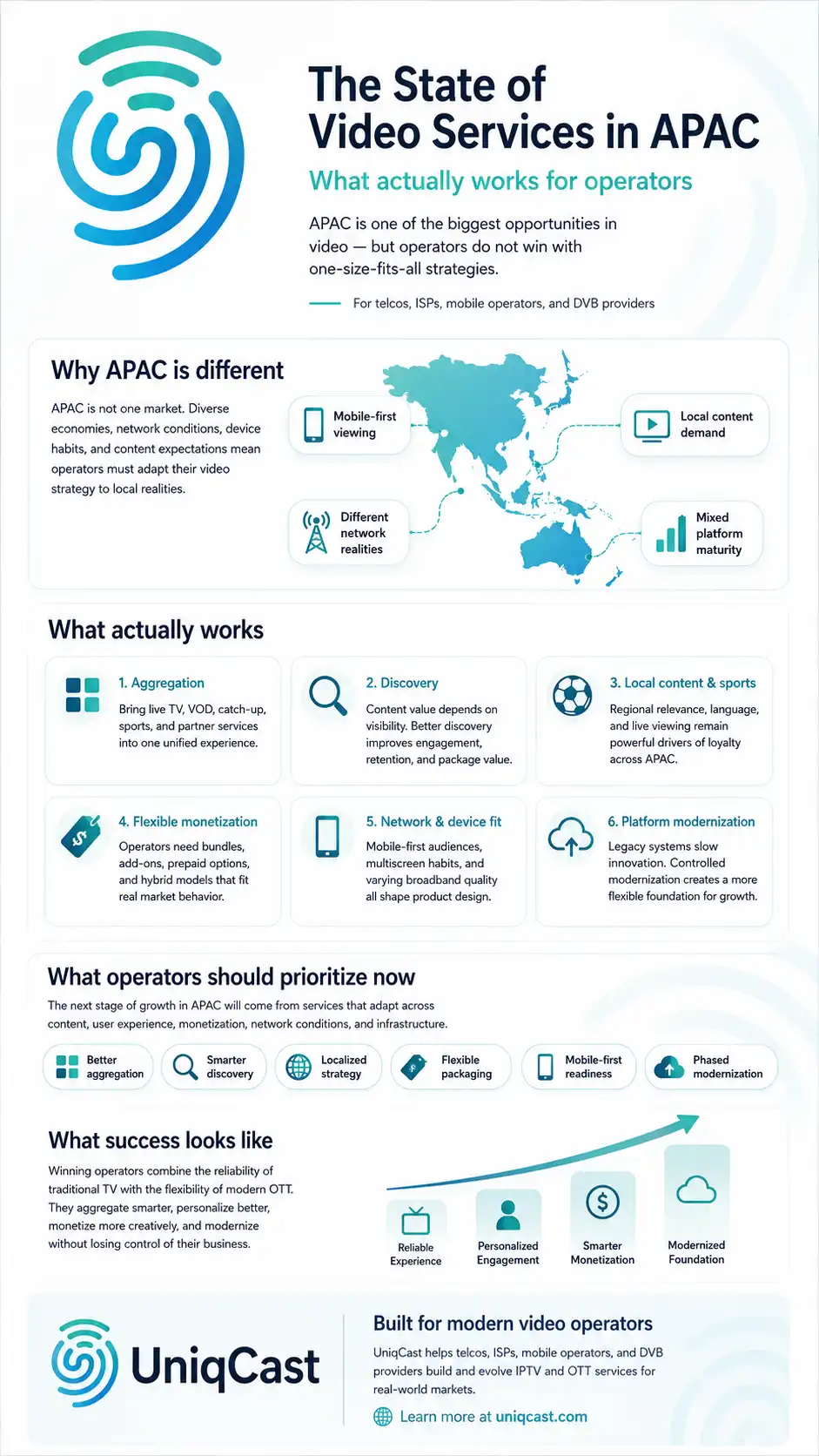
APAC Is Not One Market. It’s a Spectrum.
From highly mature markets like South Korea and Japan to fast-scaling ecosystems like India and Indonesia, operators are solving very different challenges:
- Fiber-rich vs mobile-first environments
- Premium UX vs mass accessibility
- High ARPU vs price-sensitive markets
- Mature OTT ecosystems vs emerging digital adoption
The result? There is no universal playbook.
There may be no universal playbook for APAC, but there is a clear requirement: flexibility. Operators need video platforms that can support different business models, content strategies, network conditions, device ecosystems, and migration paths without forcing every market into the same operating model.
This is especially important for service providers that already have existing IPTV, DVB, cable, or legacy OTT infrastructure. For them, transformation is about evolving the current service, protecting the existing subscriber base, and creating enough flexibility to compete with global OTT platforms, local content providers, and new video challengers.
For Mobile Operators, Video Must Fit the Data Plan
In many APAC markets, mobile is not the second screen. It is the main screen.
This changes how video services need to be designed. A mobile-first video product must be easy to activate, simple to pay for, and reliable under changing network conditions. It also needs to fit the way many users buy connectivity, especially in prepaid and price-sensitive markets.
For mobile operators, video can become more than an entertainment add-on. It can strengthen data bundles, improve customer loyalty, support prepaid engagement, and create new upgrade paths from basic access to premium content. Short-cycle passes, sports packages, data-inclusive video bundles, and app-based access can all help operators make video more relevant to mobile-first audiences.
The key is to design the service around real usage patterns. In some markets, that means affordable daily or weekly access. In others, it means premium 5G entertainment bundles. In many cases, it means both. The platform must be flexible enough to support different commercial models without creating unnecessary operational complexity.
Aggregation Is the Strategy, Not Just a Feature
In APAC, very few operators win by relying solely on their own content.
Instead, success comes from building content ecosystems:
- Integrating VOD libraries from external partners
- Combining global and regional content/catalogs
- Delivering a unified user experience
This aligns with a broader regional trend.
According to the latest e-Conomy SEA report by Google, Temasek, and Bain, the Southeast Asian internet economy is projected to surpass $330 billion in GMV, creating a massive digital distribution layer where aggregation becomes the dominant model.
The challenge is that aggregation only works when complexity is hidden from the user. Behind the scenes, operators may need to manage multiple content partners, rights windows, packages, devices, metadata sources, and billing rules. But for the subscriber, the experience must feel simple. They should be able to open the service, find something relevant, and start watching without thinking about where the content comes from.
Operators that solve this well create significantly more value than those chasing exclusivity.
The winners are not those who own the most content, but those who orchestrate it best.
Discovery Is Where Aggregation Becomes Valuable
Aggregation only works if users can find something worth watching.
This is one of the biggest challenges for video operators in APAC. As content catalogs grow, users can easily become overwhelmed by too many choices, too many content sources, and too many disconnected experiences. A service may offer live TV, catch-up TV, VOD, sports, local channels, premium partner content, and third-party applications, but if the user experience does not guide subscribers effectively, much of that value remains invisible.
Strong discovery turns a large content catalog into a usable service. It helps operators promote local and regional content, surface live events at the right moment, recommend relevant titles, and create a more personalized experience across different audience segments. This is particularly important in APAC, where content preferences can vary significantly by language, region, age group, household type, and device.
For operators, better discovery is a monetization tool. When subscribers find relevant content more easily, they watch more, stay longer, and are more likely to upgrade to premium packages or partner bundles.
Local Content and Sports Still Drive Retention
Two pillars consistently stand out:
1. Local Content
Local content in APAC is often the reason users choose one service over another.
Language, cultural identity, family viewing habits, and regional relevance all play a major role in daily engagement. International content may help attract attention, but local entertainment, news, drama, religious programming, regional channels, and national sports often create the habits that keep users returning to the service.
2. Sports
Sports have a different but equally powerful function. It anchors long-term subscriptions (retention), drives traffic peaks, supports premium packaging, and gives operators a clear reason to build loyalty around live and catch-up experiences. This applies not only to major international sports but also to local leagues and regional tournaments.
But user expectations are evolving.
Viewers increasingly expect the following:
- Instant access to key moments
- Shortened viewing formats
- Faster navigation through content
This is where features like automated highlights and key-moment discovery become critical, not as enhancements, but as baseline expectations.
The Rise of Microdramas and Short-Form Content
Short-form is no longer limited to social platforms, but it's entering structured video platforms.
Microdramas, especially in Asian markets, are
- Mobile-first
- Designed for rapid consumption
- Structured for continuous engagement
This introduces new challenges:
- Traditional VOD catalogs aren’t optimized for this format
- Discovery needs to be faster, more visual, and more dynamic
Operators that adapt their UX to support:
- scroll-based discovery
- instant playback
- continuous viewing loops
are better positioned to capture this growing segment.
Monetization Is a Product Decision, Not Just a Pricing One
APAC markets are often highly price-sensitive, but that doesn’t mean low value.
Instead, successful operators rethink monetization through:
- Flexible bundles
- Tiered access models
- Prepaid and hybrid approaches
Some markets can support premium monthly subscriptions. Others require prepaid access, lower-cost bundles, ad-supported tiers, or content packages tied to mobile data, broadband, or pay-TV subscriptions. Even within one country, different audience segments may have very different willingness to pay.
This is why monetization should be treated as a product decision, not only a pricing decision. Operators need the ability to create packages around real subscriber behavior. A mobile-first user may respond well to a short-term video pass bundled with data. A household broadband customer may prefer a family entertainment bundle. A sports fan may be willing to pay for a seasonal or event-based add-on. A traditional TV subscriber may be more likely to upgrade if OTT and multiscreen access are included as part of a broader package.
The most effective operators will be those that can test, adapt, and localize monetization models quickly. In APAC, commercial flexibility is essential to growth.
Network Reality Shapes the Product
One of the defining characteristics of APAC is variability.
Even within a single country, network quality can differ significantly.
This has direct implications:
Streaming Must Be Resilient
- Fast start times
- Stable playback under fluctuating conditions
- Efficient adaptive bitrate handling
Offline Viewing Is Essential
- Not a premium feature
- A core part of the user experience in many markets
Operators that treat offline viewing and bandwidth optimization as first-class capabilities, not add-ons, see measurable improvements in engagement and retention.
Data Is Becoming a Strategic Tool (Not Just Analytics)
Operators across APAC are increasingly leveraging data beyond recommendations.
Key use cases include:
- Understanding content performance
- Optimizing content acquisition strategies
- Tracking user behavior across segments
- Managing service performance
This creates a shift:
Data is no longer just about personalization. It’s about operational control.
Those who actively use service-level insights can:
- reduce costs
- improve engagement
- make faster, better-informed decisions
AI is accelerating this shift much faster.
Industry projections suggest that AI in media and entertainment will grow from around $15 billion today to over $50 billion by 2030. For telcos, ISPs, mobile operators, and DVB providers, AI can support the daily work of running a modern video service. It can help improve metadata, automate content tagging, strengthen search, personalize recommendations, identify churn risks, support targeted promotions, and make content operations more efficient.
In some cases, generative AI is already enabling up to 80% cost reductions in dubbing and localization workflows, fundamentally changing how content is scaled across markets. This matters in APAC because operators often manage large content catalogs across multiple languages, devices, packages, and content partners. Without better automation and data intelligence, this complexity becomes difficult to scale.
Legacy Platforms Are Slowing Down Innovation
One of the most common and least discussed challenges across the region is legacy infrastructure.
For many operators in APAC, older IPTV, DVB, cable, or OTT systems were built for a different era of video. They may still support basic service delivery, but they often make it difficult to launch new packages, integrate new content partners, support additional devices, personalize the experience, or respond quickly to changing market conditions.
This creates commercial drag. When competitors can launch new offers faster, test new bundles more easily, or deliver better multiscreen experiences, legacy limitations become visible to both the operator and the subscriber. Slow platform evolution can lead to weaker engagement, higher churn, operational inefficiency, and missed revenue opportunities.
However, the key insight is this:
The most successful transformations are not full replacements, but controlled evolutions.
Operators need to preserve what still works, reuse infrastructure where possible, migrate subscribers in phases, and add modern OTT and multiscreen capabilities without disrupting the existing base.
This approach reduces risk while enabling faster innovation.
What Actually Works in APAC
Across different markets and operator types, successful strategies tend to converge around a few principles:
- Aggregation over exclusivity
- Local content and sports as engagement anchors
- Short-form as a complementary layer—not a replacement
- Flexible, bundle-driven monetization
- Offline and resilient streaming as core capabilities
- Data-driven service management
- Gradual modernization instead of full disruption
These are not trends. They are operational realities.
Where the Market Is Heading
Looking forward, several directions are becoming clear:
- Continued expansion of aggregated content ecosystems
- Stronger role of operators as aggregators
- Continued growth of short-form and hybrid formats
- Increased focus on cost efficiency and infrastructure optimization
- Smarter UX driven by user behavior and data
- Wider adoption of AI-driven workflows and personalization
But perhaps the most important shift is this:
Video services in APAC are becoming less about launching platforms and more about continuously evolving them.
What Operators Should Prioritize Now
For APAC operators, the question is how to build a service that can grow profitably in complex, competitive, and highly localized markets.
Operators should begin by looking at the flexibility of their current platform. Can it support different business models across different markets? Can it integrate content partners quickly? Can it support live TV, catch-up TV, VOD, OTT apps, and multiscreen experiences in a unified way? Can it help users discover content more easily? Can it support mobile-first packages, prepaid models, sports add-ons, local content bundles, and hybrid monetization?
These questions matter because video services in APAC need to evolve continuously. A platform that works today but cannot adapt tomorrow will quickly become a limitation. The winning operators will be those that build enough flexibility into their video strategy to respond to new content opportunities, new devices, and new subscriber expectations.
In APAC, the best platform is the one that gives operators the freedom to adapt over time.
Final Thought
APAC doesn’t reward rigid strategies.
It rewards operators that can adapt quickly to local markets, changing devices, new content formats, and evolving monetization models.
For telcos, ISPs, mobile operators, and DVB providers, the next stage of growth will come from building a video service that can evolve continuously across content, user experience, monetization, infrastructure, and data.
The operators that succeed will be those that combine the reliability of traditional TV with the flexibility of modern OTT. They will aggregate smarter, personalize better, monetize more creatively, and modernize without losing control of their existing business.
Because in APAC, success isn’t about launching a video service.
It’s about building one that can keep up with how people actually watch.