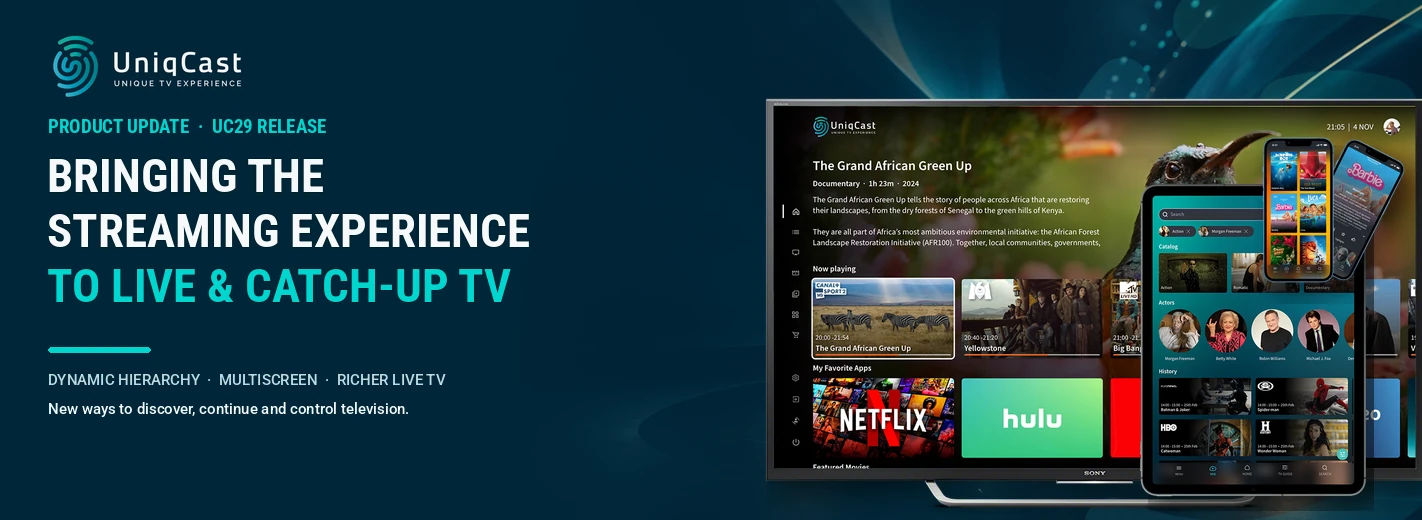
uC29 Release: Bringing the Streaming Experience to Live and Catch-Up TV
Quick Summary
Streaming services have changed how viewers expect television content to work. Audiences have become accustomed to opening a service and immediately finding clearly organized titles, seasons and episodes, continuing where they left off, exploring related information and moving easily between devices. Yet live and catch-up TV have traditionally remained much closer to their broadcast origins, organized around channels, schedules and individual programme events.
With uC29, UniqCast takes another step toward bringing these two worlds together.
At the center of the release is a new approach to Catch-up TV that automatically turns broadcast programmes into structured, streaming-style catalogues. Instead of asking viewers to search backwards through an EPG for individual episodes, the platform can recognize related programmes, group episodes into series and seasons and present them as a coherent collection. For operators, this organization happens dynamically from available metadata and predefined catalogue rules rather than requiring every series and episode structure to be maintained manually.
But the same idea extends beyond Catch-up TV. Live sports become richer with statistics and match information available alongside viewing. Navigation across Smart TV and STB becomes clearer and more intuitive. Chromecast gives viewers more control over what is playing on the television from their mobile device. Recently watched content, profile improvements and better programme information make it easier to continue viewing rather than repeatedly starting the discovery process from the beginning.
Together, these changes represent a broader direction for operator TV services: keeping the immediacy and relevance of live television while introducing more of the organization, context, convenience and continuity that viewers associate with modern streaming platforms.
At the same time, uC29 strengthens the operator side of that experience. More automated content organization, device-specific configuration, richer analytics, improved multi-operator visibility and more flexible backend management help operators deliver increasingly sophisticated services without allowing operational complexity to grow at the same pace.
General Version Highlights
Automatically Organised Catch-up TV
The biggest change in uC29 is Automatically Organised Catch-up TV, powered by Dynamic Hierarchy.
Traditional Catch-up TV is closely tied to the EPG. A viewer knows that a programme was broadcast, finds the channel and date, moves backwards through the schedule and selects the individual programme event. This works, but it does not reflect the way viewers have become accustomed to exploring episodic content on streaming services.
Dynamic Hierarchy changes that experience by using available EPG metadata and programme identifiers to understand which broadcasts belong together. Episodes of the same series can automatically be grouped under a common series entry and organized into seasons when the necessary information is available. Genre, category and tag information can also contribute to the way content is organized and discovered.
For the viewer, the difference is immediate. Instead of seeing different catch-up broadcasts as disconnected events, a drama series, for example, can appear as one series card. Opening it reveals the available seasons and episodes, making Catch-up TV feel much closer to browsing an on-demand catalogue.
Importantly, operators do not need to manually build and continually maintain these structures as new programmes enter the catch-up window. They define the catalogue rules, while the platform uses the available metadata to create and update the hierarchy automatically. As new matching episodes are ingested, they can become part of the appropriate series structure.
This creates value on both sides of the service. Viewers receive a cleaner and more familiar way to discover catch-up content, while operators can make much better use of programming that is already available without introducing a recurring manual catalogue-management task. In uC29, the Dynamic Hierarchy experience is available on Mobile, Web and Apple TV.
Sports Statistics Alongside Live and Catch-up Viewing
Live television also becomes richer in this release, particularly around sports. On supported events, STB viewers can open sports information directly from the infobar while continuing to watch the match. Depending on the information available from the sports data provider, viewers can access lineups, match statistics, player information, individual match events and standings.
The important change is not simply the availability of more data, but where that information appears. Sports statistics become part of the viewing experience rather than something the viewer needs to search for elsewhere. Combined with the existing highlights functionality, viewers can move between the broadcast, important moments and supporting match information without leaving the operator application.
More Control over Smart TV Presentation and Navigation
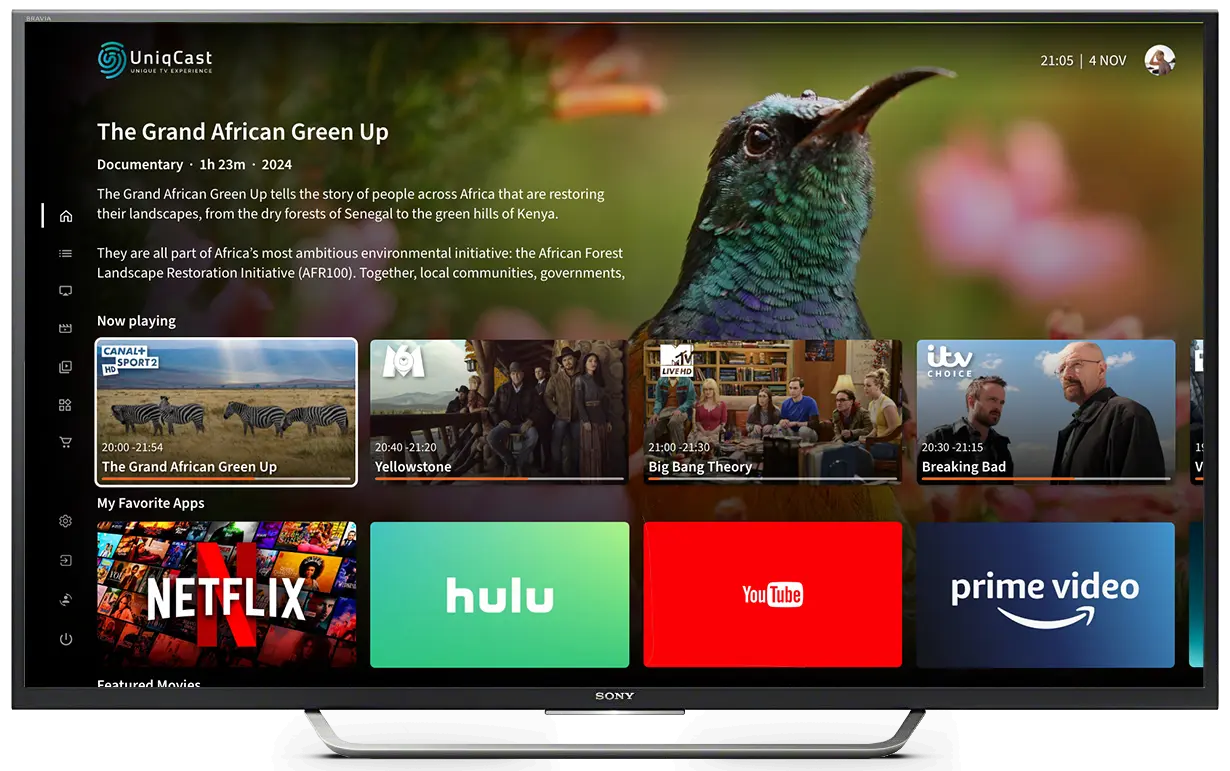
uC29 also gives operators more control over how the service is presented on different Smart TV environments. Smart TV and Smart TV Lite can now use separate theme configurations. This recognizes an important reality of multiscreen IPTV/OTT services: different device categories do not always benefit from exactly the same interface decisions. Operators can adapt presentation more appropriately while maintaining the overall identity of the service.
Navigation around live television is refined as well. Improvements to the infobar, channel list and EPG make programme information and available actions easier to understand. For channels that require an additional purchase or package, viewers can move more directly toward the available package options instead of having to find that information elsewhere in the service.
Updated Chromecast Receiver Experience
The relationship between the phone and the television also becomes more natural with the updated Chromecast receiver and corresponding mobile sender improvements. Viewers casting live, catch-up or on-demand content can use their mobile device to play or pause, seek through supported content and return to the live point of a broadcast. The phone therefore becomes a more complete controller for the television experience rather than simply the device used to start casting.
Taken together, the general improvements in uC29 move live and catch-up television closer to the convenience viewers already expect from streaming, while giving operators better ways to manage and shape that experience.
STB App Upgrades
The set-top box remains one of the most important screens for operator TV services, particularly for live television and sports. In uC29, several STB improvements focus on making this experience richer, easier to navigate and more continuous.
Sports Statistics and Highlights Navigation
Sports is one of the clearest examples. The new statistics panel is designed for remote-control navigation and allows viewers to explore available match data directly on the television. An availability indicator makes it clear when additional sports information is present, while navigation and the presentation of individual statistics have been refined to make the experience easier to use from the sofa.
Existing sports highlights remain part of this experience. Together, statistics and highlights give viewers two complementary ways to engage more deeply with an event: one provides context around what is happening, while the other makes important moments easier to revisit.
More Flexible Dashboard and Profile Experience
The STB dashboard also becomes more flexible. Operators can configure the position of dashboard menu items and can introduce a circular menu rail as an alternative navigation model. This gives services more freedom to shape the home-screen experience around their own content strategy, branding and preferred user journey rather than relying on one fixed navigation structure.
Profiles are improved as well. Viewers can change their profile avatar, and the application can automatically return to the last selected profile. These may appear to be small changes, but they reduce repetitive steps in households where different viewers regularly use the same television.
Support for recently watched episodes also strengthens continuity from the dashboard. This is particularly relevant as catch-up content becomes more series-oriented through Dynamic Hierarchy. Organizing episodes effectively is only one part of the streaming experience; helping viewers easily return to what they were already watching is equally important.
Package-Level Upsell Options
uC29 also introduces additional possibilities for package-level upselling. Operators can connect specific platform capabilities with package entitlements and use these capabilities as tangible reasons to upgrade. One example is an entitlement that allows viewing to continue without the standard inactivity timeout. Rather than upselling only more channels or content, operators can therefore include specific service benefits within higher-value packages.
More Detailed Playback Analytics
For operators, understanding what happens during playback is just as important as improving what viewers see on screen. The NPAW integration in uC29 therefore provides additional content identifiers, custom dimensions and application events. This gives operational teams more context when analyzing playback behaviour and investigating how the application and content delivery experience are performing.
Playback and Programme Information
Several smaller refinements improve everyday viewing as well. Audio and subtitle languages are identified more clearly, EPG information in the channel list is refreshed more effectively, and error presentation has been improved. Together, these changes help viewers understand the available playback options, current programme information and potential problems more easily.
Mobile and Web Features
Mobile and Web play an increasingly important role in connecting traditional television with the on-demand behaviour viewers have learned from streaming services. In uC29, this is where the new Dynamic Hierarchy approach to Catch-up TV becomes especially visible.
Automatically Organised Catch-up TV on Mobile and Web
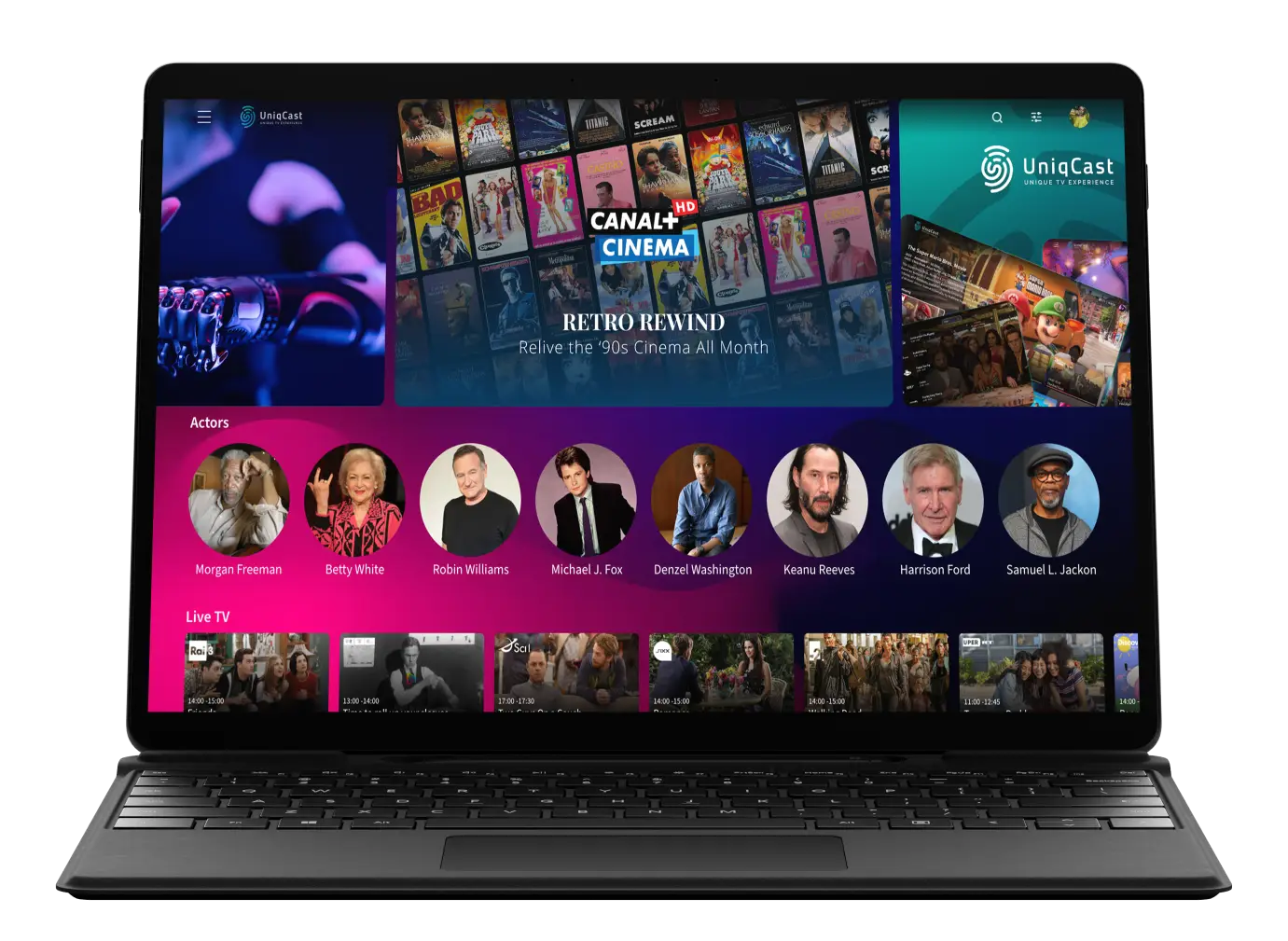
Catch-up series and episodes can now be automatically grouped and presented as structured collections on Mobile and Web. Instead of browsing individual programme events, viewers can enter a series, see the available episodes and navigate the catalogue more naturally.
Collection and detail screens have been designed around this new structure, with improved episode information helping users understand what is available. Pagination also makes longer series easier to browse without creating an overwhelming screen.
The change demonstrates why automatic content organization matters. Catch-up libraries can contain a large amount of valuable programming, but the usefulness of that content depends heavily on how easily people can find and understand it. By transforming broadcast events into recognizable series and episode structures, operators can present existing catch-up content in a way that feels much closer to a purpose-built streaming catalogue.
Mobile Usage Analytics with Firebase
Mobile analytics are also extended in uC29 through additional Firebase event tracking. This gives teams more information about how viewers use the mobile application and how they move through different parts of the experience. Better understanding of these user journeys can help operators identify friction, understand feature usage and make more informed decisions about future improvements.
Chromecast Sender Updates
Mobile also takes on a stronger role in the television experience through Chromecast. The updated mobile application coordinates playback and seeking with the new Chromecast receiver, allowing viewers to control what is happening on the TV directly from the phone. When supported by the content, viewers can pause, seek within the programme and return to the live broadcast.
Smart TV
Smart TVs allow operators to bring the full service directly onto connected televisions, often across devices with very different capabilities. uC29 gives operators more flexibility in adapting the experience to those differences while continuing to refine everyday live-TV navigation.
Device-Specific Themes
One important change is the ability to configure Smart TV and Smart TV Lite themes separately. Operators no longer need to apply the same visual configuration to both device categories. This allows the service to preserve a common identity while adapting presentation according to the capabilities and practical requirements of each environment.
Clearer Live TV and EPG Navigation
Live TV and EPG navigation receive a broad set of usability improvements. Circular navigation within the EPG makes movement through programme information more natural, while viewers can move more easily between events on the timeline. Channel feature icons are clearer, catch-up dates are presented more visibly, and thumbnails and channel-list metadata have been improved.
These changes may individually be small, but together they address an important part of the television experience: helping viewers understand what is on, what was previously available, what actions they can take and where they can go next without adding unnecessary complexity.
Content presentation outside live TV is improved as well. VOD title artwork can be presented more effectively, while profile avatars in header layouts help make the service feel more personal and make the active profile clearer.
Easier Access to Available Packages
uC29 also simplifies the journey from discovering a channel to understanding how to access it. When a viewer reaches a purchasable channel, the Show Packages flow provides a more direct route to the relevant package options. Reducing unnecessary navigation at this moment is important because the viewer has already demonstrated interest in the content. The service can therefore make the commercial path clearer without forcing the user to search through separate subscription areas.
Sidebar refinements further improve navigation, while the EPG day range now follows the operator's configured settings more consistently. This also brings Smart TV behaviour into closer alignment with the STB experience.
Smart TV Lite Refinements
Smart TV Lite receives additional attention for environments where hardware capabilities or remote-control behaviour may differ from newer Smart TVs. Grid behaviour has been updated, navigation indicators have been improved, and handling of remote controls on supported legacy devices has been refined. The objective is to make browsing and selection clearer even when the service is running on more constrained television hardware.
Apple TV
Automatically Organised Catch-up TV on Apple TV
Apple TV joins Mobile and Web in supporting one of the central additions of uC29: automatically organized Catch-up TV.
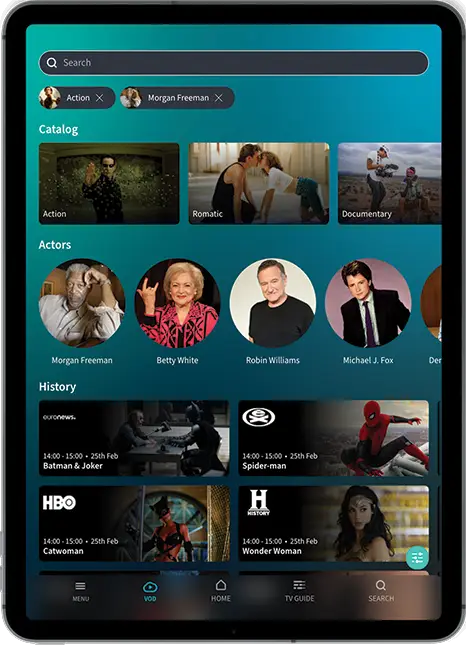
Dynamic Hierarchy allows catch-up series and episodes to be presented as structured collections on Apple TV rather than simply as individual EPG events. This is particularly relevant on the large screen, where viewers are already accustomed to navigating streaming applications through title, series and episode views.
Collection and detail screens make these catch-up catalogues easier to explore, while improved series previews provide better context before the viewer makes a selection. Pagination supports longer series with larger numbers of available episodes.
The result is an Apple TV catch-up experience that feels much closer to browsing an on-demand streaming service while still being created from the operator's broadcast and catch-up content.
Backend
Many of the most visible improvements in uC29 depend on changes that viewers will never directly see. The backend work in this release is therefore an important part of the story, because it allows operators to introduce richer services while reducing some of the manual effort and operational complexity behind them.
Automatic Catch-up Catalogue Management
Dynamic Hierarchy is a good example. The backend now supports automatic grouping of catch-up content and includes refinements around category filtering, season ordering and content expiry. Operators maintain the rules that determine how catalogues should behave, while the platform resolves the underlying content structure.
This is what makes automatically organized Catch-up TV scalable in practice. A streaming-style catalogue is valuable to the viewer, but it would become operationally expensive if every new episode, season or programme had to be manually placed in the correct hierarchy. uC29 moves much of that recurring work into the platform itself.
VOD and EPG Label Management
Content management becomes more flexible in other areas as well. VOD and EPG labels can now be managed centrally in CSMS. The same label information is also available through the relevant APIs and search index, giving operators a more consistent base for categorization, discovery and future service logic across different parts of the platform.
Sports Data and More Reliable Highlight Processing
The richer sports experience on the STB is similarly supported by backend improvements. Sports statistics can be ingested and connected with the corresponding EPG events so that relevant information becomes available alongside viewing.
Highlight processing has also been strengthened. Revised scheduling and improvements in the handling of situations such as extra time, disallowed goals, reruns and match-event timing make the highlight service more reliable across the complexities of real sports broadcasts. For the viewer, the goal is straightforward: important moments and related information should appear correctly even when the match itself does not follow the simplest possible timeline.
Device-Specific SSAI Configuration
Advertising configuration also becomes more device-aware. For operators using the Broadpeak integration, server-side ad insertion can be enabled according to device class, while relevant content and viewing context can be passed through the delivery chain. This gives operators more control over how advertising is applied across different device categories rather than requiring one identical setup everywhere.
Better Multi-Operator Visibility
For services operating across multiple operators, uC29 improves visibility inside CSMS. Dashboard counters can be displayed by operator, allowing operational teams to examine activity for a specific operator more directly. Additional subscriber-status counters provide a clearer view of the subscriber base and its current activity.
Device Management and API Auditing
Device management follows the same multi-operator direction. Operators can manage devices within the appropriate operator scope rather than treating the environment as one undifferentiated device population.
Administrative transparency is improved through auditing of Admin and Provisioning API activity. Operations teams gain a record they can consult when investigating administrative changes or trying to understand what happened within the platform. As IPTV/OTT environments grow across more operators, integrations and administrative users, this type of visibility becomes increasingly important for efficient troubleshooting and day-to-day platform governance.
Provider Ingest Consistency
Finally, uC29 continues to improve the consistency of content coming from external providers. Updates to the SonyLIV, Digiturk and Megogo integrations refine translation handling and provider configuration. Digiturk live and VOD category handling has also been improved, helping externally ingested content arrive in the platform in a more organized and consistent way.
Bringing Broadcast and Streaming Closer Together
With Dynamic Hierarchy, Catch-up TV can increasingly behave like a streaming catalogue without becoming a manually maintained VOD library. Sports broadcasts can include richer context and more reliable highlights. Different device types can receive more appropriate presentation, advertising and navigation. Operators gain better analytics, clearer multi-operator visibility and more control over platform operations.
This is the direction behind uC29: bringing more of the intelligence, organization and convenience of streaming into the live and catch-up television experience, while making that richer service practical for operators to manage at scale.
Live television remains live. Catch-up remains connected to the operator's broadcast service. But the way viewers discover, understand, continue and interact with that content can increasingly meet the expectations established by modern streaming platforms.
With uC29, UniqCast brings those experiences closer together.